Malaysia Night Markets and Food Markets: The Complete Guide for Food Travelers
Discover Malaysia's best night markets, hawker centers, and morning markets. Complete guide to pasar malam across KL, Penang, Langkawi, and Melaka with tips on what to eat and market etiquette.
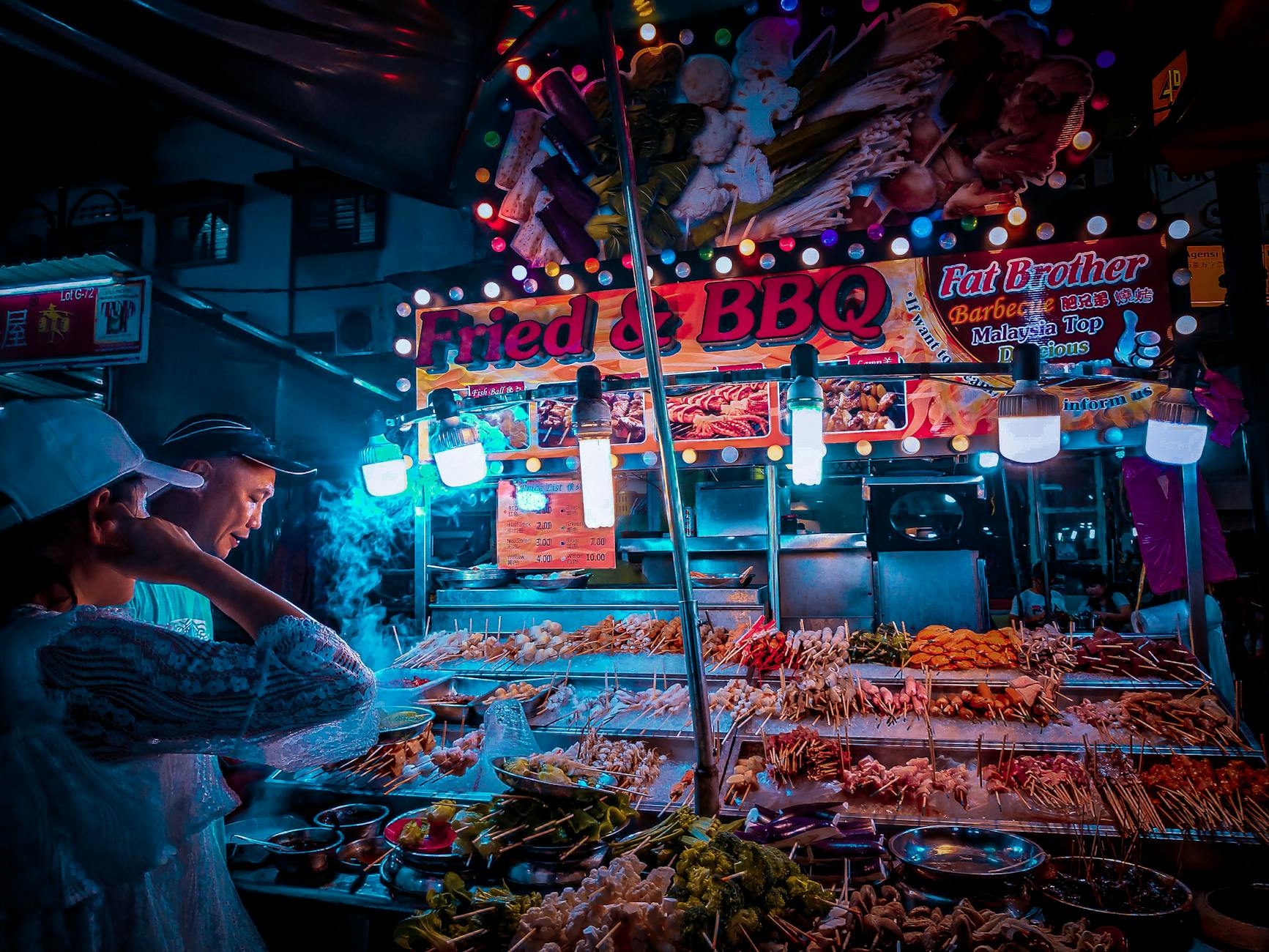
It’s 5:30 PM on a Wednesday in Cheras, and the street that was perfectly ordinary an hour ago is now completely impassable. Seven hundred stalls stretch ahead of you for two kilometres. Smoke rises from a dozen charcoal grills at once, the smell of satay mixing with fried onion and fresh coconut. You’re at Taman Connaught — the largest night market in Malaysia — and you haven’t eaten yet, which is either brilliant planning or a serious mistake depending on how well you navigate what comes next.
Malaysian food markets run on a logic that rewards the prepared visitor. The pasar malam (night market) rotates weekly by neighbourhood. The hawker center operates daily, sometimes for decades, its best stalls passing down recipes through generations. The morning market opens before dawn and sells out by noon. Each type gives you something different, and knowing which one you’re walking into changes how you experience it. This guide covers all three — what they are, where to find the best ones across the country, what to order, and how to handle yourself without looking lost.
Understanding Malaysia’s Food Market Types
Three distinct market formats shape how Malaysians eat outside the home. They serve different purposes, operate on different schedules, and have their own unspoken rules. Get the basics right and every market visit runs smoothly.
Pasar Malam (Night Markets)
Pasar malam means night market, and the name is accurate: these are evening events, weekly, rotating by neighbourhood. Each area of a city or town gets its designated night — one street closes to traffic from around 4 to 5 PM, vendors set up along both sides, and the market runs until 10 or 11 PM. Next week, a different street gets its turn.
The food is predominantly takeaway. Vendors pack individual portions into styrofoam boxes or banana leaf, many items are priced between RM2 and RM10, and the expectation is that you walk and graze rather than sit down for a formal meal. You’ll also find clothing, mobile phone cases, toys, and household goods mixed in — but nobody comes to a pasar malam for a phone case. The food stalls cluster together naturally, and the queue length at any given stall tells you everything you need to know about quality.
These markets are the most accessible entry point for visitors. No reservation, no seating anxiety, no language barrier beyond the basics. You point, you pay, you eat while walking. The atmosphere is genuinely communal — families, schoolchildren still in uniform, elderly couples, teenagers — all moving through the same narrow corridor of smoke and colour.
Hawker Centers and Food Courts
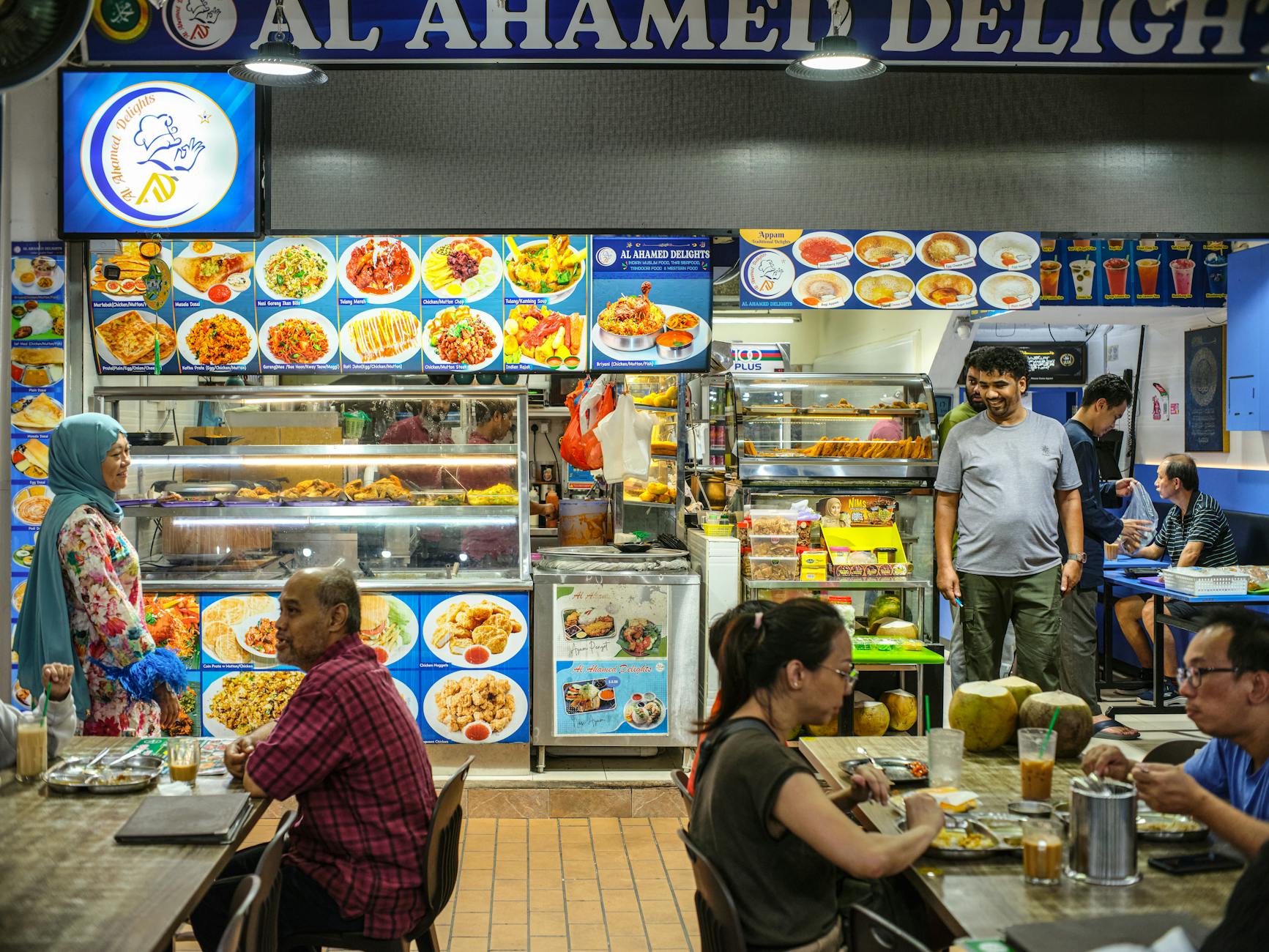
Where pasar malam are temporary and rotating, hawker centers are permanent — sometimes operating from the same address for forty or fifty years. A hawker center is a collection of independent stalls grouped around shared tables and chairs. Each stall runs its own kitchen, takes its own orders, and collects its own payment. Most stalls have perfected one or two dishes and do nothing else, which is exactly why the quality can be so high.
The layout ranges from open-air concrete spaces with ceiling fans and plastic chairs to covered complexes attached to housing estates, and further up to air-conditioned food courts inside shopping malls. The open-air versions tend to deliver the more honest experience — hotter, louder, and with better food. Prices sit between RM4 and RM12 for most dishes, which remains one of the best value propositions in Malaysian dining.
The golden rule of hawker centers: find your seat first, then order. Vendors need somewhere to send your food. In busy centers, tables fill up fast and you may need to share with strangers — this is standard practice and nobody takes offence. Once seated, walk to whichever stalls interest you, place your order directly, and pay each stall separately when the food arrives or when you collect it. At very crowded hawker centers, locals reserve tables by placing a tissue packet or small personal item on a chair — a practice known as choping. It looks odd if you haven’t seen it before, but it’s completely accepted.
Pasar Pagi (Morning Markets)
Morning markets operate on a schedule that requires actual commitment: vendors arrive before dawn, and the freshest produce sells out early. By noon, most stalls have packed up. If you make the effort, what you find is a version of Malaysian food culture that hasn’t been adjusted for tourists at all.
The primary business of a pasar pagi is raw ingredients — fish, vegetables, meat, tropical fruit, eggs, fresh spices, tofu, and fermented goods that supply the surrounding neighbourhood’s home kitchens. Woven through all of this are prepared food stalls selling breakfast items: nasi lemak wrapped in banana leaf, roti canai still warm from the griddle, kuih in neat rows, and strong teh tarik poured from height into paper cups. These food vendors are not performing for visitors; they’re feeding the people doing the shopping.
Among the largest morning markets in the country, Pasar Pudu and the Chow Kit market in Kuala Lumpur draw wholesale buyers as well as neighbourhood shoppers. The sensory experience at either — the sharp smell of dried shrimp, the cool mist over ice-packed fish, the towers of rambutan — is hard to replicate anywhere else. Penang’s morning markets in George Town are worth the early alarm for anyone following the island’s penang food guide seriously.
Best Night Markets by Destination
Kuala Lumpur
KL’s night market network is enormous — different nights, different suburbs, very different characters. A visitor staying a week could hit a different pasar malam every evening and never repeat the experience. Here are the ones worth planning around.
Taman Connaught Night Market runs every Wednesday in Cheras and is, without argument, the largest night market in Malaysia. Over two kilometres of stalls — more than 700 of them — line the closed streets with food running the full range from traditional Malay staples to Chinese-Malaysian snacks to trendy fusion items that didn’t exist five years ago. The scale alone is worth experiencing once. Go hungry and arrive early; the popular stalls can sell out.
TTDI Night Market operates every Sunday in Taman Tun Dr Ismail, from around 5 PM. Compared to Connaught it’s smaller and noticeably calmer — a neighbourhood market serving a neighbourhood, which means the food reflects what locals actually eat rather than what vendors think visitors want. Good mix of Malay and Chinese-Malaysian options, relaxed atmosphere, easy to navigate.
SS2 Night Market in Petaling Jaya runs on Monday evenings and has a loyal following built on consistently good Chinese-Malaysian street food. This one draws regulars who come back for specific stalls, which is always a reliable signal.
Kampung Baru Night Market sits inside the historic Malay village right in the middle of KL. The entire food selection is halal, and this is where you come for strong traditional Malay cooking — proper satay, nasi lemak served with more accompaniments than the standard packet version, grilled fish, and a kuih selection that makes other markets’ kuih sections look thin. If you want to understand Malay food specifically, this is the right market.
Jalan Alor in Bukit Bintang functions more like a permanent hawker street than a rotating pasar malam, but it delivers the same concentrated food-market energy every evening from around 5 PM until the early hours. Grilled seafood, satay, char kway teow, chicken wings, noodle soups — the street is bright, loud, and easy to find from the city centre. It’s the most tourist-visible option and works well as a first-night introduction to kuala lumpur food guide territory before you go deeper into the neighbourhood markets.
Penang
Penang’s food reputation is built on its hawker centers more than its night markets, though the island has both. The depth of cooking at the best permanent stalls here — some operating from the same spot for fifty years — is difficult to match elsewhere in the country.
Gurney Drive Hawker Centre has been operating since the early 1970s along the waterfront, and it remains the most comprehensive single collection of Penang hawker food anywhere. Char kway teow, Hokkien mee, lok lok, mee goreng, pasembur, rojak, satay — the breadth of what you can eat at a single visit is the point. Come in the evening when the full complement of stalls is running and the sea breeze makes the outdoor seating bearable.
New Lane Hawker Centre (Lorong Baru) opens each afternoon when the street closes to traffic. This is a more local atmosphere than Gurney Drive — fewer tourists, less English on the menus, better char kway teow. Also worth trying: the chee cheong fun and the fried oyster omelette. The best time to arrive is 5 to 6 PM when the widest selection of stalls are fully operational.
Chulia Street in George Town’s UNESCO heritage zone wakes up after dark. Wonton mee, curry mee, popiah, ais kacang — the food stalls here are convenient if you’re already exploring the old town’s shophouses and street art, and the food quality is solid throughout.
Batu Ferringhi Night Market runs along the beach road in the main tourist accommodation strip. It’s the most touristy of the Penang options — souvenirs and clothing dominate — but the food section has a reasonable range of local favourites including satay and grilled seafood. It’s the easy choice if you’re staying in Batu Ferringhi and don’t want to travel into George Town at night.
Langkawi
Langkawi runs a full seven-day rotating pasar malam system, one location per night of the week. This means no matter when you’re on the island, there’s a night market somewhere within reach. The schedule: Ulu Melaka on Monday, Kedawang on Tuesday, Kuah on Wednesday, Bohor Tempoyak on Thursday, Air Hangat on Friday, Padang Matsirat on Saturday, Padang Lalang on Sunday. Confirm locally before going, but this rotation has been consistent for years.
These markets are smaller and quieter than anything you’d find in KL or Penang. The food skews heavily traditional Malay — nasi lemak, ikan bakar, satay, mee goreng, and a good kuih section. The Kuah night market near the ferry jetty is the most accessible for visitors and consistently the most affordable on the island, with some items starting at RM1.50. If you’ve come from a big-city pasar malam, the smaller scale takes some adjustment, but the food is genuinely good and the atmosphere is distinctly local.
Melaka
Jonker Street Night Market runs every Friday and Saturday evening through the heart of Melaka’s heritage district. The market is distinct from urban pasar malam in that it’s as much cultural as culinary — antiques, Peranakan crafts, and heritage shophouses line the route alongside the food stalls. The food itself reflects Melaka’s Nyonya heritage: chicken rice balls, cendol made to order, Nyonya kuih in unusual flavour combinations. The setting is genuinely atmospheric in a way that most night markets can’t replicate.
If you’re in Melaka mid-week when Jonker Street is quiet, the Ayer Keroh and Klebang areas both have their own pasar malam that operate on other nights. Less architecture, more food, more local crowd — a different but worthwhile experience.
East Malaysia
Kota Kinabalu has Gaya Street, which closes to traffic every Friday and Saturday evening and fills with 100-plus stalls. Laksa, nasi lemak, satay, and Sabahan specialties — dishes specific to this corner of Borneo that you won’t find easily in Peninsular Malaysia — make this worth seeking out. The waterfront market area nearby focuses on fresh seafood, which in KK means very fresh seafood indeed.
Kuching, in Sarawak, gives you two different things. The Satok Weekend Market runs Saturday and Sunday mornings with a fascinating combination of Malay and Dayak produce — jungle ferns, unusual fruits, wild-caught fish — alongside prepared Sarawakian food. The Carpenter Street area in the old town comes alive with evening food stalls most nights, where Sarawakian Chinese cuisine gets its own showcase.
What to Eat at Malaysia’s Food Markets
The full spread of Malaysian market food is too large to catalogue here — that’s what the must try malaysian food list is for. But certain dishes are specifically suited to the market format and should be at the top of your ordering list.
Satay is the defining night market food. Skewers of chicken, beef, or lamb grilled over live charcoal, served with peanut sauce, compressed rice cakes (ketupat), and fresh cucumber and onion on the side. The markers of quality are straightforward: visible charcoal rather than gas, a queue, and skewers coming off the grill fresh rather than sitting in a warming tray. Cheap gas-grilled satay and excellent charcoal satay exist at roughly the same price point, so the queue is your best guide.
Nasi lemak packets are everywhere, and there’s a reason: they work perfectly as a quick, portable, complete meal. Coconut-scented rice, sambal, fried anchovies, peanuts, and a boiled or fried egg, all wrapped in banana leaf or newspaper. Night market versions often come with added proteins — fried chicken, rendang, sambal squid — for a few ringgit more. Price range is RM2 to RM10 depending on what you add. This is one of the most reliable orders at any pasar malam.
Ikan bakar — charcoal-grilled fish basted with sambal and cooked wrapped in banana leaf — is one of the great pleasures of malaysian street food. Find a stall with a charcoal grill and fresh fish on display, point at what you want, and wait. Served with sambal and lime. Eat it hot.
Kuih are the traditional Malay sweets and cakes that show up at every market in colourful, carefully arranged rows. Made from glutinous rice, coconut milk, palm sugar, pandan, tapioca, and various rice flours, they come in over twenty distinct varieties — some steamed, some baked, some fried, some wrapped in banana leaf. Individual pieces cost RM1 to RM2, which makes buying five or six different types an entirely reasonable strategy. The colours are natural — pandan gives green, butterfly pea flower gives purple-blue, palm sugar gives brown — and the textures range from dense and chewy to light and airy.
Murtabak is a stuffed flatbread — minced meat, egg, and onion folded into a thin pastry and pan-fried on a large flat griddle until crispy. Served with curry sauce for dipping. Watching it get made is part of the experience; the preparation is theatrical and takes a few minutes, which is worth waiting for.
Apam balik is a crispy pancake sold in two versions. The thin, crunchy version gets filled with crushed peanuts, sugar, and creamed corn, then folded and cut into portions. The thick version is softer, more like a thick pancake. Both are good; the crispy version is the one most people mean when they talk about apam balik. It’s a genuinely satisfying sweet snack and nearly impossible to eat too much of.
Fresh tropical fruits are available at every market, with vendors selling pre-cut portions of watermelon, mango, papaya, pineapple, guava, and jackfruit. Seasonal additions include durian (pungent, divisive, unmissable if you’re serious about Malaysian food), mangosteen (delicate, sweet-tart), and rambutan (small, hairy-skinned, refreshing). Markets are one of the best places to try unfamiliar fruits because vendors will often let you taste before buying.
Practical Tips for Market Visitors
A few habits separate the confident market visitor from the one standing in the middle of a pasar malam looking confused while everyone else eats.
Bring cash, specifically small notes. The vast majority of vendors accept only cash. RM1, RM5, and RM10 notes are the most useful — many vendors struggle to break RM50 bills during busy periods. Some larger modern hawker centers now accept digital payment apps like Touch ‘n Go, but don’t count on it. Withdraw cash before you go.
Arrive between 5 and 6 PM for the best selection at night markets. Early enough that most stalls are fully set up and running, late enough that the evening rush hasn’t hit yet. Popular items — especially satay and certain kuih varieties — sell out as the night progresses. Arriving later means a longer market atmosphere but a narrower food selection.
Read the queues, not the menus. High turnover is the single most reliable quality signal at any Malaysian market. A stall with a constant stream of customers is preparing food fresh and moving it fast. A stall with food sitting under a heat lamp and no queue deserves more scrutiny. Local customers are not forgiving of mediocre food — if they’re queueing, there’s a reason.
Wear shoes with grip. Market floors — especially at open-air sites — get wet and greasy as the evening progresses. Cooking oil, spilled drinks, and the occasional tropical shower all contribute. Flip-flops on a greasy hawker center floor at 8 PM is an accident waiting to happen.
Carry a water bottle. Between the tropical heat and the warmth radiating from dozens of cooking stalls in a confined space, you will get thirsty. Most markets have fresh coconut water, sugarcane juice, and other cold drinks at very reasonable prices, so replenishment is never far away — but starting hydrated makes the whole experience more comfortable.
Graze widely rather than committing early. Walk the full length of the market first, or at least a substantial portion, before you start buying. Identify the stalls with queues, spot the dishes you want, and then backtrack. Filling up at the first three stalls means missing whatever is best at stall sixty.
Learn “tak pedas” (not spicy) if your tolerance is low. Many dishes at Malaysian markets carry real heat — sambals, curry sauces, and spiced marinades are standard rather than optional. Some dishes can be adjusted; many can’t. Knowing the phrase and using it early, when ordering, is more effective than asking them to reduce the heat after the food is already cooked.
Food Safety and Hygiene at Markets
Open-air cooking, warm evenings, and unfamiliar ingredients: the combination makes some visitors nervous. The risk is real but manageable, and for most travellers with a healthy gut the food safety record at established Malaysian markets is excellent.
The most important variable is turnover, which keeps coming back as the central quality indicator for a reason. A stall that sells out of char kway teow every twenty minutes has no food sitting around long enough to develop a problem. A stall cooking to order — satay off the grill, murtabak from a fresh piece of dough — carries minimal risk because the cooking process itself eliminates bacteria. Prioritise these.
Pre-cooked food displayed in warming trays requires more judgment. Hot food kept properly hot (visibly steaming) is generally fine. Food that looks like it’s been sitting at ambient temperature for a while deserves more caution — the heavy chili, salt, and vinegar in many Malaysian sambals and pickles act as preservatives, but they’re not infallible.
Ice is safe to consume at Malaysian markets. This is a common concern and the worry is understandable — in some countries, commercially produced ice is not guaranteed to be made from clean water. In Malaysia, it is. Ice factories use filtered water, the product is widely trusted by locals and long-term expats alike, and iced drinks are a genuine pleasure in the tropical heat. Order the fresh lime juice over ice without hesitation.
If you have a sensitive digestive system, pace yourself on the first few days. Not because the food is unsafe, but because the combination of spices, coconut milk, fermented sauces, and unfamiliar preparation methods is genuinely different from what most visitors are used to. Start with simply-cooked, freshly-prepared dishes and build up to the more adventurous options as your system adjusts.
Market Etiquette
None of the etiquette rules at Malaysian markets are arcane or difficult. They’re mostly just practical habits that keep things moving smoothly for everyone.
At hawker centers, sit first, then order. This isn’t a preference — it’s functional. Vendors need an address to send your food to. Once you’ve found a spot, hold it with a tissue packet, an umbrella, or a small personal item on the chair (choping). In very busy centers this is the only way to secure a seat before the lunch or dinner rush hits.
Return your plates and utensils to the stall or to the designated collection area after eating. Not everyone does this, but it’s considered good form and makes the cleanup staff’s job significantly less grim. At night markets, dispose of packaging in the provided bins rather than leaving it on whatever surface happens to be nearby.
Don’t haggle over food prices. Food pricing at Malaysian markets is fixed — the number on the board or the price the vendor states is the price. Attempting to negotiate a lower price for your plate of char kway teow will not go well and is considered disrespectful. Non-food items at night markets (clothing, accessories, phone accessories) sometimes have a small margin for polite negotiation, but even there the practice is less common than in some neighbouring countries.
Photography is generally fine and often welcomed. Market vendors are accustomed to their food being photographed, and a beautifully presented kuih display or a charcoal satay grill in full operation is genuinely photogenic. The courtesy is to ask before pointing a camera directly at a person’s face — most vendors will either smile and wave you on or actively arrange something for you, but the ask is worth making.
How to Work a Malaysian Market
Malaysian food markets are not complicated, but they reward a particular approach. Walk before you eat. Read the queues before you read the menus. Carry cash in small denominations. Arrive at 5 or 6 PM. Order one thing from this stall, one thing from that one, and keep moving until you’ve covered enough ground to know what you actually want.
The pasar malam, the hawker center, and the morning market each give you a different angle on Malaysian food. The night market is the most immediate and sociable. The hawker center is where serious cooking gets its most concentrated showcase. The morning market shows you the raw materials — the produce and spices and fresh catch that become everything else. Between the three, you get a more complete picture of Malaysian food culture than any restaurant-only itinerary can provide.
Start with Taman Connaught on a Wednesday evening if you’re in KL and want scale. Go to Gurney Drive on a Tuesday night in Penang if you want depth. Find the Kuah market on Wednesday in Langkawi if you want to understand what small-town Malaysian market life actually looks like. And at any of them — sit down, order too much, share a table with a stranger, ask what that thing in the green leaf is, and eat it.
1 note