Thaipusam at Batu Caves: Malaysia’s Most Spectacular Festival (2027)
Thaipusam 2027 falls on Friday 22 January. The four-day schedule, how the date is set, getting to Batu Caves when seven roads are closed, what time to arrive and how to behave.
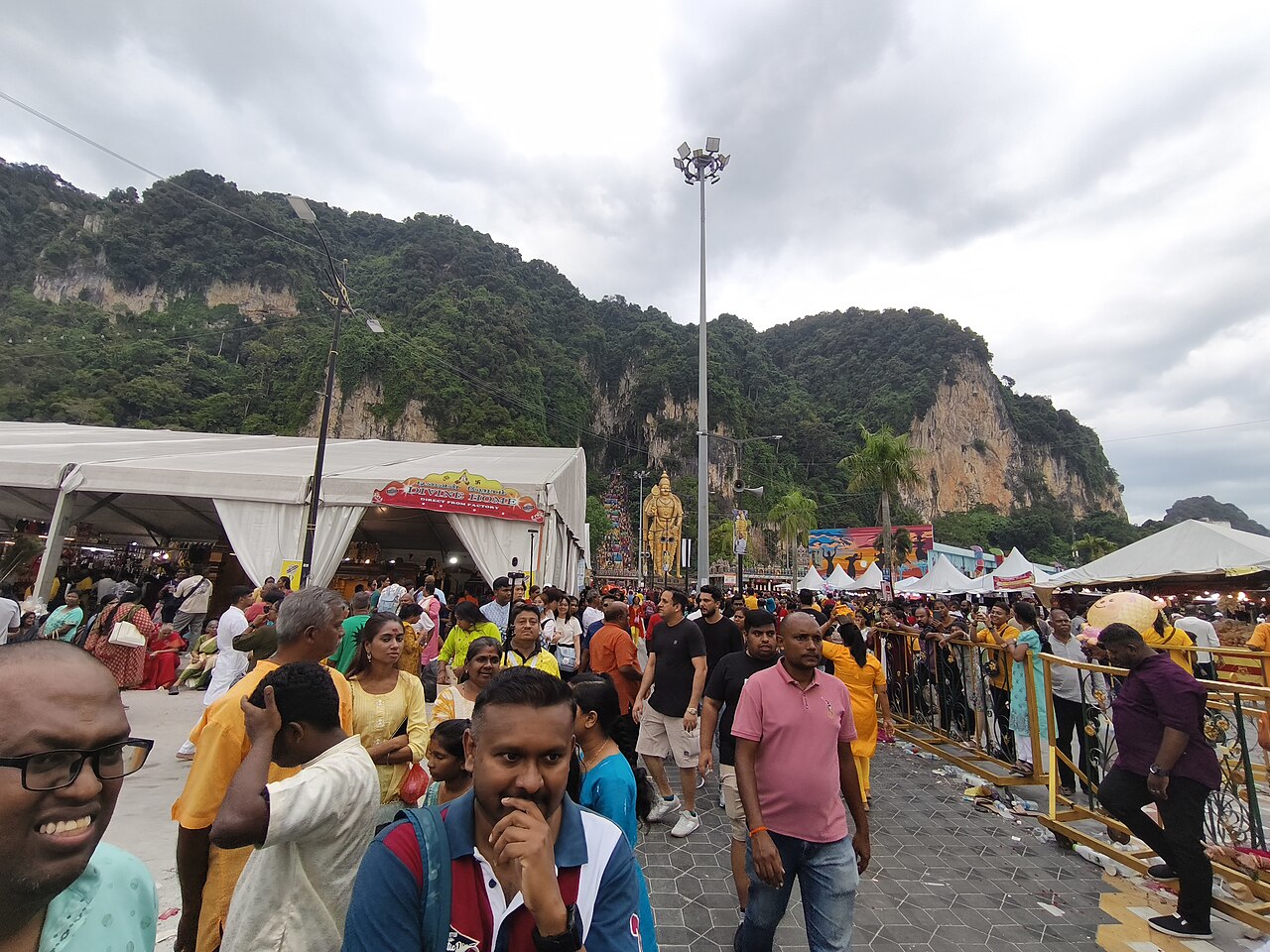
Between one and a half and two and a half million people climb 272 steps at Batu Caves each year for Thaipusam, and a significant number of them do it carrying a steel frame attached to their bodies by hooks and skewers driven through the skin of their back, chest and cheeks.
That sentence is the honest summary, and it is why Thaipusam at Batu Caves is the most extraordinary thing a visitor can see in Malaysia. It is not a performance, there is no ticket, and nothing about it has been arranged for tourists. It is a Hindu vow-fulfilment festival that happens to take place on the outskirts of a capital city, in front of a 42.7-metre gold statue, on a scale found nowhere else in the world including India.
Thaipusam 2027 falls on Friday 22 January — and because it lands on a Friday, the crowds will run into the weekend in a way they did not in 2026. This guide covers the date and why it moves, the four-day schedule, how to get there when seven roads are closed, what time to arrive, and how to behave.
When is Thaipusam?
| Year | Date | Day | Note |
|---|---|---|---|
| 2027 | 22 January | Friday | Kedah observes an additional day on Sunday 24 January |
| 2028 | 13 February | Sunday | Monday 14 February is an additional holiday in seven states |
Almost every guide says Thaipusam falls on “the full moon of the Tamil month of Thai”, which is close but not right, and the difference explains why the date sometimes surprises people.
The festival is set by the Poosam (Pushya) nakshatra — a lunar mansion, one of 27 divisions of the moon’s path — prevailing on the full-moon day of the Tamil month of Thai, which corresponds to Makara and runs from mid-January to mid-February. It is the nakshatra, not the moon phase alone, that fixes the day. That is why Thaipusam can fall anywhere across a four-week window and why the dates do not simply track the Gregorian calendar backwards each year.
Is it a public holiday?
Not federally, which surprises visitors. Thaipusam is gazetted in Johor, Kedah, Kuala Lumpur, Negeri Sembilan, Penang, Perak, Putrajaya and Selangor — the states with substantial Tamil populations. It is an ordinary working day in Kelantan, Melaka, Pahang, Perlis, Sabah, Sarawak, Terengganu and Labuan.
Practically, this means offices and many shops in Kuala Lumpur, Selangor and Penang close, hotel rates in those areas rise, and the roads are quieter than a normal Friday everywhere except around Batu Caves and the Penang temples, where they are impassable. Our Malaysia festivals calendar sets out the state variation for every holiday in the year.
What actually happens, and over how many days
Thaipusam is one day on the calendar and roughly four in practice. Based on the pattern of recent years, the 2027 schedule should run approximately as follows — treat the chariot timings as projected until the temple confirms them, usually a few weeks beforehand.
| When | What |
|---|---|
| Wed 20 Jan, evening | Silver chariot departs the Sri Mahamariamman Temple on Jalan Tun H S Lee in central KL |
| Thu 21 Jan, morning | Chariot arrives at Batu Caves after travelling overnight; crowds build through the day |
| Fri 22 Jan | Thaipusam. Peak crowds; kavadi bearers climb from before dawn until late at night |
| Sat 23 Jan | Chariot returns to the Sri Mahamariamman Temple in the city |
The chariot procession
The silver chariot carrying the image of Lord Murugan leaves the Sri Mahamariamman Temple in Kuala Lumpur’s Chinatown — the oldest Hindu temple in the city — in the evening, typically around 9pm. It covers roughly 15 km to Batu Caves via Jalan Raja Laut, Jalan Dang Wangi and Jalan Tun Razak, stopping constantly as devotees along the route make offerings of coconuts, fruit and camphor.
Reports of the journey time vary widely — news coverage has cited around eight hours, while accounts from people who have walked the whole thing suggest considerably longer. The safest expectation is that it travels overnight and arrives the following morning. Walking a stretch of the route at 11pm, among tens of thousands of people, with drumming and camphor smoke and coconuts being smashed on the road, is a better experience than most of what happens at the caves themselves.
What the kavadi is
Thaipusam commemorates the day the goddess Parvati gave her son Murugan a divine spear, the vel, to defeat the demon Surapadman. The festival is about vows: a devotee who has asked Murugan for something — recovery from illness, a child, deliverance from a crisis — and received it, discharges the debt by carrying a burden.
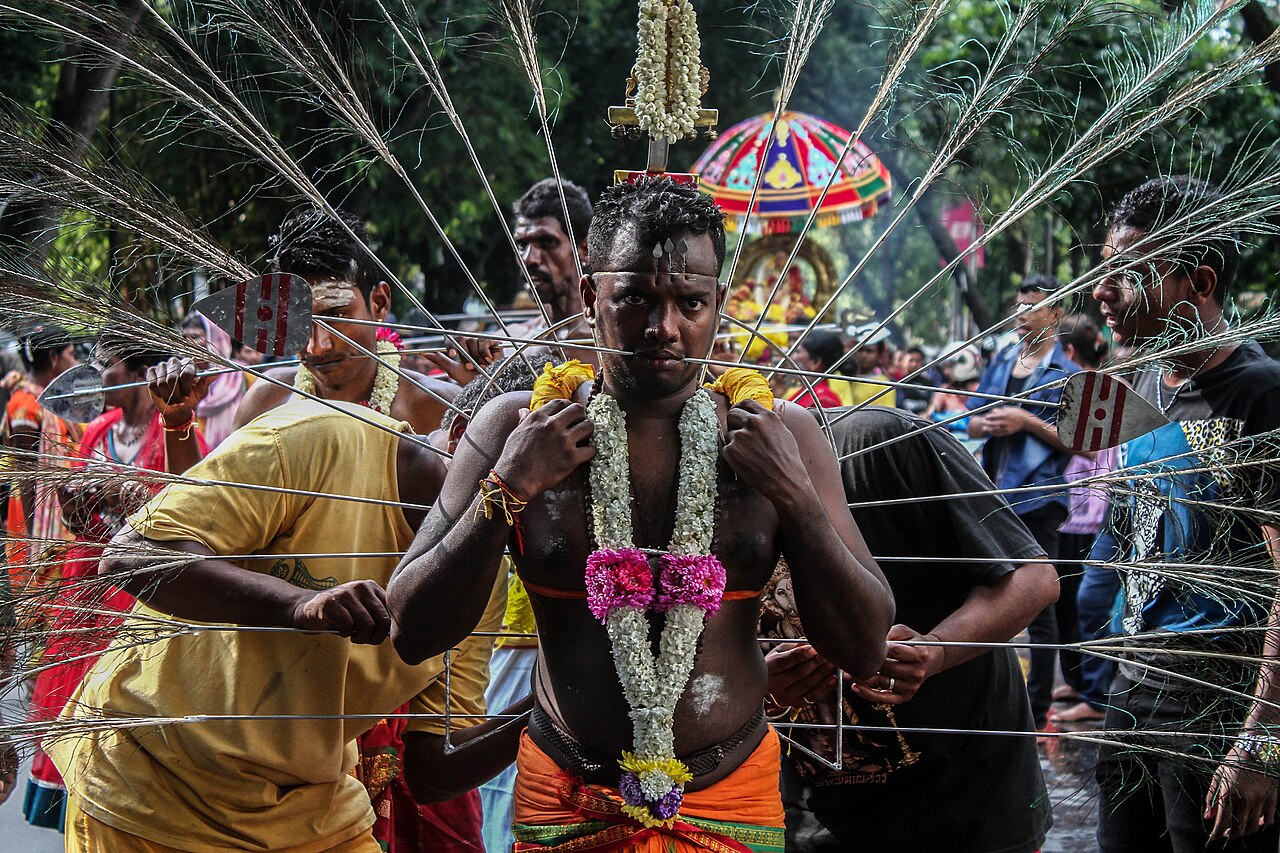
The burden takes several forms. The paal kudam is a pot of milk carried on the head, the most common and the least dramatic. The kavadi proper is an arched frame of steel and peacock feathers, sometimes two metres high and weighing 30 kg or more, borne on the shoulders. The vel kavadi adds skewers through the cheeks and tongue and hooks set into the skin of the back and chest, sometimes with small pots or limes hanging from them. Many devotees shave their heads. Some are in a trance state, sustained by drumming and chanting, and appear to feel no pain — a phenomenon widely observed and not well explained.
None of this is spontaneous. Devotees prepare for 48 days beforehand with fasting, a strict vegetarian diet, celibacy and prayer. Understanding that changes how the day looks: what appears to a visitor as extremity is the last stage of a seven-week discipline.
Getting there
Batu Caves sits about 13 km north of central Kuala Lumpur, and on Thaipusam the normal advice about driving is simply void. Seven roads around the site were closed for four days in 2026, and parking within walking distance does not exist.
KTM Komuter — the right answer
The Komuter line from KL Sentral runs directly to Batu Caves in about 40 minutes. It is the eighth stop and the line terminus, so you cannot overshoot. The normal fare is RM2.60 in cash or RM2.30 with a Touch ‘n Go card.
For Thaipusam, KTM transforms the service. In 2026 the line ran 24 hours a day for four days and three nights, added 216 extra trips, expected around 700,000 passengers, and made travel free for the two peak days. Expect something similar in 2027, announced a week or two beforehand.
The catch is the return journey, which almost every account of Thaipusam underplays. Leaving Batu Caves between roughly 10am and 4pm on the main day means queueing for a train in full sun among a very large number of people. Either leave before 9am or plan to stay into the evening.
Free shuttle buses
Rapid KL ran 30 free shuttle buses at ten-minute intervals in 2026, from the Pasar Seni Hub, LRT Gombak and MRT Kampung Batu. These are a good alternative when the trains are at their worst, particularly on the way back. Watch for the announcement of the 2027 arrangements in the local press in early January.
Grab and taxis
Possible on the approach, impractical on the day. Surge pricing is severe, and road closures mean a driver will drop you a long walk short of the site anyway. If you must use one, book for very early morning and walk the last stretch. Our getting around Malaysia guide covers the network generally.
What time to arrive
| Time | What it is like |
|---|---|
| Before 5am | Dark, cool, dense with devotees. The most intense hours and the best photography light at dawn |
| 5–8am | The sweet spot. Kavadi processions arriving continuously, heat still manageable, steps moving |
| 8am–noon | Peak crowds and peak heat. The staircase becomes a slow queue |
| Noon–4pm | Hottest and most congested. Return transport is at its worst |
| 4pm–late | Crowds thin, temperature drops, processions continue into the night |
The consensus among people who have done this more than once is to arrive around 5am. You will see the most, in the best light, at the most bearable temperature, and you can be on a train back before the worst of it. If a 4am start is unrealistic, the late afternoon and evening are the second-best window and are widely underrated.
Bring water, wear something you can sweat through, and accept that you will be moving slowly in a crowd for several hours. Sandals are better than trainers for the steps. Our what to pack for Malaysia guide covers the general climate question.
Etiquette and photography
Non-Hindus are entirely welcome. There is no entry fee to the site or the Temple Cave, no restriction on foreign visitors, and Malaysian Hindus are generally pleased that outsiders take an interest. That welcome comes with obligations.
- Dress modestly. Shoulders and knees covered, for men as well as women. Shoes come off before entering the temple areas.
- Ask before close-up photography. Wide shots of the crowd and the staircase are fine. A close photograph of someone’s pierced cheek, taken without acknowledgement, is not. Most devotees will consent if asked; some are in a trance state and cannot, in which case do not.
- Do not use flash on devotees, particularly those in trance.
- Give way. Kavadi bearers and their supporting parties have absolute right of way on the steps and in the cave. Step aside, and do not stand in a procession’s path for a photograph.
- Do not treat it as spectacle. This is a religious observance in which people are discharging serious personal vows. The distinction between witnessing and gawping is visible from the outside.
- Watch the monkeys. The macaques on the staircase are bold and will take food, sunglasses and phones. This is unrelated to etiquette but it is the most common thing that goes wrong.
Our Malaysian cultural etiquette guide covers the broader rules, and Malaysian culture and heritage explains the Tamil community’s place in the country.
Batu Caves outside Thaipusam
If your dates do not line up, Batu Caves is worth a morning at any time of year and it is one of the easiest half-days in Kuala Lumpur.
The site is free to enter and open roughly 6am to 9pm, with some sources putting the opening at 5:30am. The 272 steps lead to the Temple Cave, a limestone cavern with a hole in the roof through which light falls onto the shrine at the back. The 42.7-metre gold Murugan statue at the foot of the stairs is the tallest of its kind anywhere.
The rainbow paint on the steps, which is now the reason most people photograph the place, dates only from August 2018. It was applied by around a hundred volunteers over two and a half days during the kumbhabhishekam, a consecration ritual held every twelve years — and the National Heritage Department publicly stated that the repainting had not been approved, since the site is a listed heritage location. It has stayed.
Two side attractions charge admission: the Ramayana Cave at around RM15, with painted dioramas of the epic, and the Cave Villa at roughly RM10–15. Neither is essential. The Dark Cave, which ran genuinely excellent guided conservation tours through an undeveloped cave system, has been closed since January 2019 and has not reopened, though a startling number of itineraries and tour listings still include it. If someone offers to sell you a Dark Cave tour, they are selling something that does not exist.
Go at 7am on an ordinary day and you will have the staircase largely to yourself before the heat and the tour buses arrive. Our Kuala Lumpur travel guide and day trips from Kuala Lumpur guide place it in a wider day, and best temples in Malaysia covers the country’s other major sites.
Where else Thaipusam is celebrated
Batu Caves and Penang dominate the coverage, but Thaipusam is observed wherever there is a substantial Tamil community. Ipoh holds a chariot procession to the Sri Subramaniar Temple at Gunung Cheroh, set against the limestone cliffs of the Kinta Valley, and the crowds are a fraction of those in Kuala Lumpur. Johor Bahru runs a large procession through the city centre. Smaller observances take place in Klang, Seremban and across the old estate towns of Perak and Selangor.
If the scale of Batu Caves puts you off — and two million people in one place is a legitimate reason to hesitate — Ipoh is the sensible alternative. You will see the same rituals, the same kavadi, the same chariot, with room to stand and no queue for a train home. Our Ipoh travel guide covers the city, which is worth two nights in its own right.
Batu Caves or Penang?
Almost every guide treats Penang’s Thaipusam as a footnote. It is not. Penang draws well over a million people, possibly around 1.5 million in recent years, and many who have attended both consider it the more intense of the two.
| Batu Caves, KL | Penang | |
|---|---|---|
| Attendance | 1.8–2.5 million | Over 1 million |
| Chariots | One silver chariot from Sri Mahamariamman Temple | Two — a silver chariot dating from 1894 and a gold chariot from 2017 |
| Destination | The 272 steps and the Temple Cave | Waterfall Hilltop Temple and Nattukkottai Chettiar Temple |
| Scale of setting | Vast; the statue and staircase dominate | More intimate, street-level, denser |
| Crowd handling | Extra trains, free shuttles, road closures | Street processions through the city itself |
| Best for | The single most photographed image of the festival | Atmosphere, proximity, thoroughfares lined with free food stalls |
Penang’s gold chariot, commissioned by the Penang Hindu Endowments Board in 2017, stands 6.71 metres and travels to the Waterfall Hilltop Temple, while the silver chariot — in service since 1894 — goes to the Nattukkottai Chettiar Temple. The streets along the routes fill with thaneer panthal, stalls giving away free food and drink to anyone passing, which is a tradition Kuala Lumpur has on a smaller scale.
If you can only do one, Batu Caves for the image and the sheer scale, Penang for the feeling of being inside it. If you are spending time in Penang anyway, our Penang travel guide covers the city.
Frequently asked questions
When is Thaipusam 2027 and is it a public holiday?
Friday 22 January 2027. It is a public holiday in Johor, Kedah, Kuala Lumpur, Negeri Sembilan, Penang, Perak, Putrajaya and Selangor, with Kedah observing an additional day on Sunday 24 January. It is not a federal holiday and is an ordinary working day in the other states. Thaipusam 2028 falls on Sunday 13 February.
Why does the Thaipusam date change every year?
Because it is fixed by the Hindu Tamil calendar rather than the Gregorian one. Thaipusam falls when the Poosam nakshatra — one of 27 lunar mansions — prevails on the full-moon day of the Tamil month of Thai, which spans mid-January to mid-February. The nakshatra, not the full moon alone, determines the day, which is why the date can move by up to four weeks between years.
How do I get to Batu Caves for Thaipusam from KL?
Take the KTM Komuter from KL Sentral — about 40 minutes, RM2.60 in cash or RM2.30 with Touch ‘n Go, and Batu Caves is the line terminus. For Thaipusam the service typically runs 24 hours for several days with hundreds of extra trips, and has been free on the peak days. Rapid KL also runs free shuttle buses from Pasar Seni, LRT Gombak and MRT Kampung Batu. Do not drive: seven roads around the site are usually closed.
What time should I arrive at Batu Caves on Thaipusam?
Around 5am. You get the dawn light, the most intense processions and a manageable temperature, and you can leave before the midday crush. The window from 8am to 4pm is the hottest, the most crowded and the worst for the return journey. Late afternoon and evening are the underrated second-best option, with processions continuing well into the night.
Can non-Hindus attend Thaipusam? Is there a dress code?
Yes, non-Hindus are welcome and there is no entry fee. Dress modestly with shoulders and knees covered, for men as well as women, and remove your shoes before entering temple areas. Give way to kavadi bearers at all times, and be conscious that you are a guest at a religious observance rather than a spectator at an event.
Is it OK to photograph kavadi bearers and piercings?
Wide shots of the crowd, the staircase and the chariot are entirely fine. For close-ups of individual devotees, ask first — most will consent, and a nod is enough. Do not photograph anyone in a trance state without the agreement of the family or supporting party accompanying them, and do not use flash. The distinction between respectful documentation and intrusion is obvious to everyone present.
How many people go to Batu Caves for Thaipusam?
Figures vary depending on whether they count a single day or the whole festival period. Around 1.8 million were reported at Batu Caves in 2025 and about 2.5 million were expected in 2026, with some reports citing up to 3.5 million across several days. Whichever figure you take, it is the largest Thaipusam gathering anywhere in the world, including India.
Is Thaipusam better in Penang or at Batu Caves?
Batu Caves is bigger and produces the iconic images — the 272 rainbow steps beneath the gold statue. Penang draws over a million people to two chariot processions, one silver dating from 1894 and one gold from 2017, and the celebration runs through city streets lined with stalls giving away free food, which makes it feel more immediate. If you are already in Penang, do not travel to Kuala Lumpur for it.
Planning a trip around it
Thaipusam is the best festival in Malaysia to build a trip around, for a practical reason as much as a cultural one: it is over in a day, it closes nothing, and it falls in January when the west coast weather is good and the east coast islands are shut anyway. A week based in Kuala Lumpur and Penang in late January covers Thaipusam, the run-up to Chinese New Year and the best of the peninsula’s food.
Book accommodation near a Komuter station rather than near Batu Caves itself, and book it early — rates in Kuala Lumpur and Selangor rise for the holiday. Our 7 days in Malaysia itinerary gives a route that works around it, and the Malaysia festivals calendar covers what else falls nearby in the year.
1 note