Mulu National Park: Caves, Pinnacles & Sarawak’s Crown Jewel
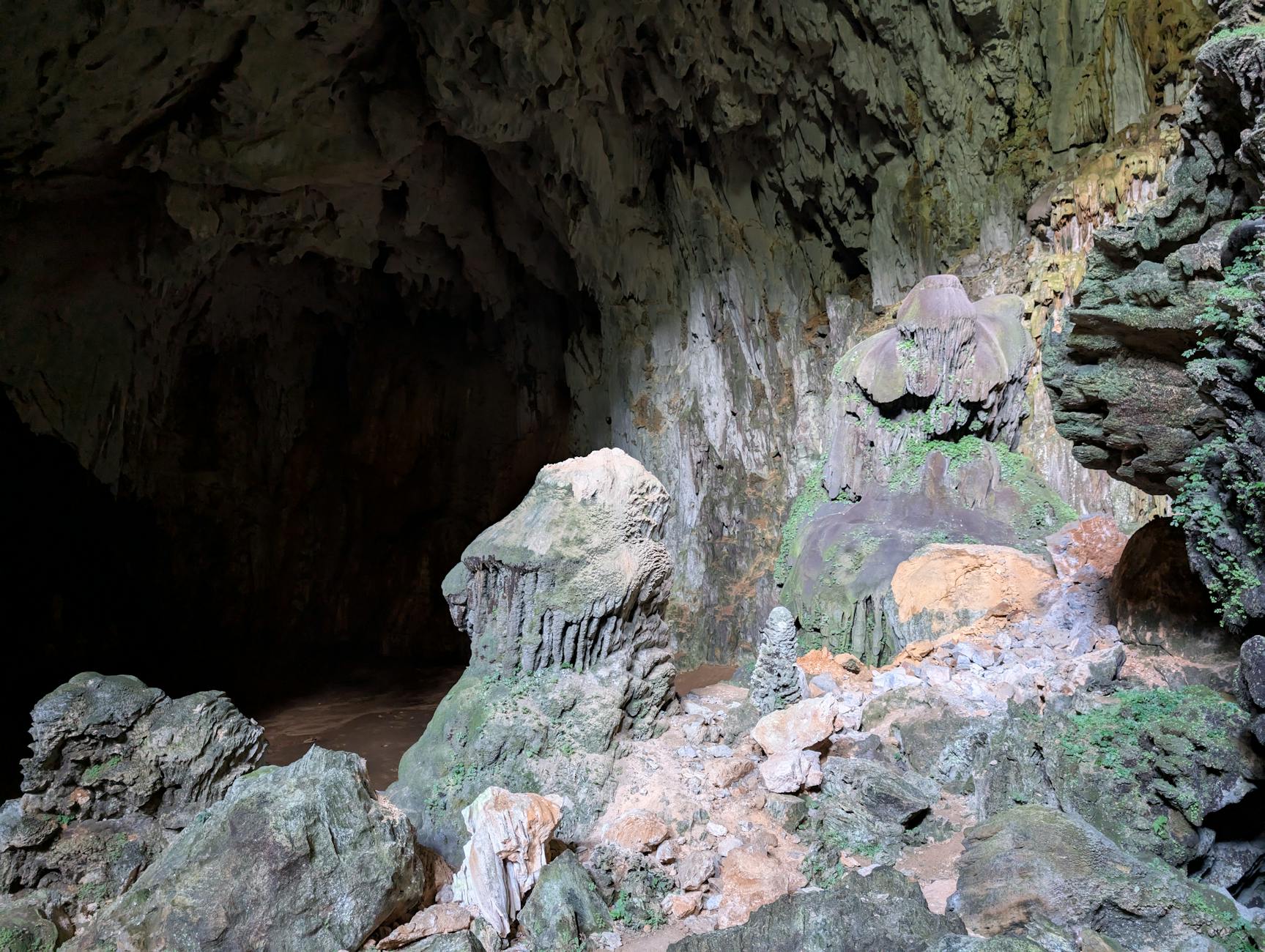
The statistics for Mulu National Park in Sarawak are difficult to absorb. The Sarawak Chamber is the largest known cave chamber in the world by area. The Deer Cave houses between two and a half and three and a half million bats. The Clearwater Cave system extends over two hundred and sixty-five kilometres of surveyed passages — and exploration continues to add new passages each year. All of this sits inside five hundred and twenty-nine square kilometres of pristine Bornean rainforest, a UNESCO World Heritage Site since 2000 for its outstanding geological and biological values.
But Mulu is not just a cave destination. The surrounding forest holds significant wildlife — all eight Bornean hornbill species, bearded pigs, Bornean gibbons, sun bears, the elusive bay cat — and the park trail network covers limestone pinnacles and heath forest habitats found nowhere else in Malaysia. Above ground, seventeen distinct vegetation zones support over four thousand plant species, two hundred and sixty-two bird species, and seventy-five mammal species. The caves and the forest are inseparable here; one makes no sense without the other. For the broader Malaysia wildlife context, our malaysia wildlife guide connects all the major destinations.
The Show Caves
The four show caves have been developed for visitor access with plankwalks, concrete paths, and lighting that illuminates their extraordinary formations while protecting the delicate cave environment. All four can be visited as guided day trips from park headquarters, making them accessible to visitors of all fitness levels. They are the centrepiece of any Mulu visit.

Deer Cave and the Bat Exodus
The most visited cave in the park and home to one of the world’s most dramatic wildlife spectacles. Deer Cave measures over two kilometres in length and reaches heights of one hundred and seventy-four metres — a space so vast that a Boeing 747 could comfortably fly through the main chamber. The cave takes its name from the deer that were once observed entering to lick salt deposits from the floor. Enormous colonies of bats cling to the ceiling far above, their collective presence detectable before you even enter by the distinctive ammonia smell rising from the guano-covered floor.
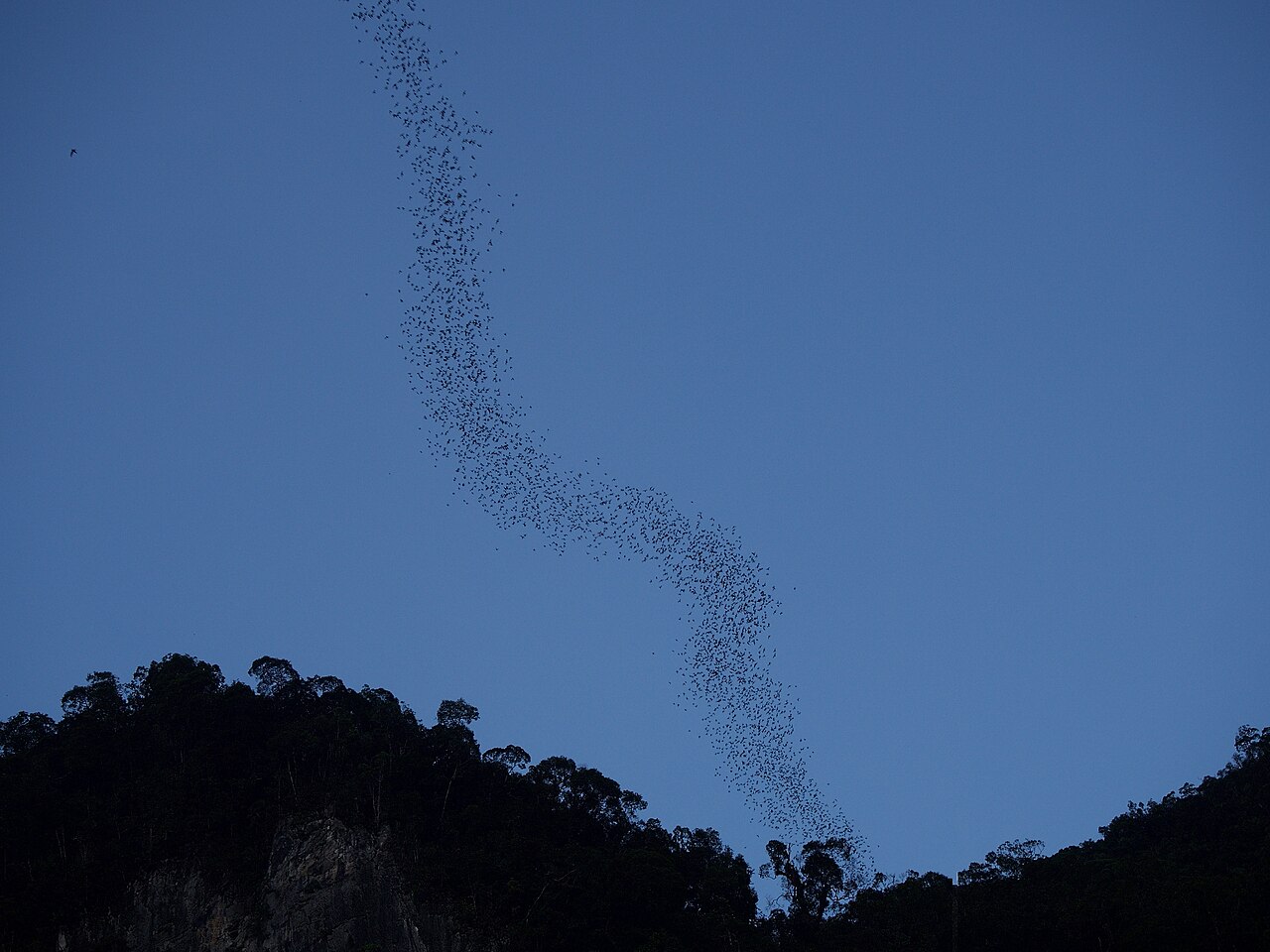
The bat exodus happens every evening. An estimated two and a half to three and a half million bats — at least twelve species, dominated by wrinkle-lipped free-tailed bats — stream out of the cave mouth in dense, spiralling ribbons that twist across the evening sky as the colony departs for its nightly feeding. The exodus typically begins between five-thirty and six-thirty, though it can start as early as four in the afternoon depending on conditions. It lasts thirty to forty-five minutes. The colony consumes an estimated thirty tonnes of insects each night. Bat hawks and other raptors circle above and pick bats from the swirling stream with remarkable precision. On rare occasions heavy rain at dusk will delay or prevent the exodus, but on most evenings it proceeds reliably. Watching from the covered bat observatory near the cave entrance is included in the Deer Cave tour at no additional cost.
Lang Cave
Adjacent to Deer Cave and visited on the same evening tour, Lang Cave is smaller and offers something entirely different: an intimate examination of cave formations at their finest. Delicate curtain stalactites, flowstone cascades, impressive columns, and intricate mineral deposits sculpted by water chemistry over millions of years fill a space that feels like a geological jewellery box after the overwhelming scale of Deer Cave. Cave racer snakes hunt bats near the entrance. Cave crickets congregate in darker corners. Blind cave fish move through the pools. The tour to Deer Cave and Lang Cave costs RM35 per person and takes approximately three hours. Tours depart from park headquarters at two in the afternoon, with the three-kilometre plankwalk through the forest providing opportunities to spot birds, butterflies, and other wildlife on the way.
Clearwater Cave and Wind Cave
Clearwater Cave contains the longest cave system in Southeast Asia — over two hundred and sixty-five kilometres of surveyed passages as of 2025, with new sections still being added. You reach the show cave by a thirty-minute longboat ride up the Melinau River, itself excellent for wildlife with kingfishers, hornbills, and monitor lizards visible along the banks. From the river, you climb approximately two hundred steps to the cave entrance, where a river passage with remarkably clear water flows over smooth white limestone. Swimming in the natural pool at the cave entrance is one of the most refreshing things you can do at Mulu.
Wind Cave, located nearby and visited on the same tour, earns its name from the cool breeze that flows through its passages. The King’s Chamber inside contains an impressive array of stalactites, stalagmites, flowstone formations, and moonmilk deposits — water and limestone chemistry over geological time on full display. Dense roosts of black-nest swiftlets occupy the upper sections. The combined Clearwater Cave and Wind Cave tour costs RM70 per person including the guide fee and longboat transfer. Tours depart daily at eight forty-five or nine-fifteen in the morning and take approximately four hours. An alternative four-kilometre nature trail connects the park headquarters to the caves for those who prefer to walk one way.
Sarawak Chamber
The Sarawak Chamber is the largest known cave chamber on the planet, measuring approximately six hundred metres long, four hundred and fifteen metres wide, and up to two hundred and seventy metres high — a space that could contain forty Boeing 747 aircraft side by side. Access is strictly limited to specialist adventure caving teams; standard show cave tours do not include it. Reaching the chamber requires a full day of strenuous trekking and caving, including a three-hour hike along the Mulu Summit Trail to Good Luck Cave, followed by approximately three hours navigating an eight-hundred-metre river channel with sheer rock faces rising fifty metres on either side. An overnight stay at Camp 1 is compulsory. The expedition is restricted to experienced and physically fit cavers aged sixteen and above. Contact park management well in advance if this is a specific goal.
The Pinnacles Trek
The Pinnacles of Gunung Api are razor-sharp limestone formations — some towering up to fifty metres — sculpted by millions of years of tropical rainfall dissolving the surrounding limestone until only the hardest core remains. They erupt from the forested slopes of Mount Api like a forest of grey stone spires, one of the most alien and dramatic natural landscapes in Borneo. Reaching the viewpoint is a serious physical undertaking, but the reward is one of the most spectacular sights in all of Malaysian Borneo.
Getting to Camp 5
The Pinnacles trek is offered only as a three-day two-night package because reaching the starting point requires a journey deep into the park. On day one, you travel by longboat up the Melinau River to Kuala Litut, then walk nine kilometres along the river to Camp 5 — approximately three to four hours through relatively flat lowland forest. Many visitors combine this day with a visit to Clearwater Cave en route, making it a full and rewarding first day.
Camp 5 is a basic but functional forest shelter at the foot of Gunung Api, sleeping up to thirty-eight guests on raised timber platforms with sleeping mats provided. There are no doors, no windows, and no insect screens — you are in direct contact with the sounds and atmosphere of the surrounding rainforest. Cooking facilities and basic toilets are available; food is included in the package. Spending a night in this remote jungle camp, listening to the forest and watching stars through gaps in the canopy, is worthwhile in its own right regardless of the climb the next day.
The Climb to the Viewpoint
Day two is the main event. The trail from Camp 5 to the Pinnacles viewpoint covers just two and a half kilometres in distance but ascends approximately twelve hundred metres through increasingly demanding terrain. The lower sections pass through forest, but the upper sections involve scrambling over jagged limestone on all fours, hauling yourself up near-vertical sections using fixed ropes and ladders, and navigating terrain where the razor-sharp limestone can cut through clothing and skin. Sturdy gloves are not optional — they are essential.
The park has established four checkpoints with strict cut-off times to ensure all climbers reach the viewpoint and return safely before dark. Miss any cut-off and you will be turned back regardless of how close you are to the top. For fit trekkers, the ascent takes two to three hours; average fitness should allow four to five hours. The descent is often harder than the ascent — steep, slippery, and demanding on the knees — and can take three to five hours. At the viewpoint, the surreal landscape of stone spires rising from dense green forest with the Melinau River valley stretching away below is worth every minute of effort. The Pinnacles trek package costs approximately RM530 per person for a group of five, rising to approximately RM1,057 for a solo trekker, reflecting guide, boat transfer, and Camp 5 accommodation costs. Park entry of RM30 for international adults is additional. If rain makes the limestone too dangerous, the climb may be cancelled on safety grounds — factor this into planning, particularly during the wetter months.
The Headhunters Trail
One of Borneo’s most evocative trekking routes follows the path once used by Kayan headhunting parties who paddled up the Melinau River to the Melinau Gorge and then crossed the mountains to raid settlements in the Limbang valley. Today it is a multi-day jungle trek that provides an alternative exit from Mulu — one that avoids retracing your steps and takes you deeper into the forest before emerging by river at Limbang.
The trail begins at Camp 5, making it a natural extension of the Pinnacles trek. From Camp 5, the eleven-kilometre route leads through lowland forest to Kuala Terikan on the Terikan River — approximately four to five hours of walking. At Kuala Terikan, you board a longboat for a river journey that eventually connects to the town of Limbang, from where flights return to Miri or you continue your travels. The route can also be done in reverse, starting from Limbang. Multi-day packages combining the show caves, Pinnacles trek, and Headhunters Trail typically span four to five days and represent the full Mulu experience — underground exploration, summit trekking, and river travel through remote rainforest in one trip.
Adventure Caving
Beyond the four show caves, Mulu offers adventure caving in wilder, undeveloped systems where the only light comes from your headlamp and the only path is the one your guide picks through the darkness.
Racer Cave is the entry-level experience, suitable for reasonably fit visitors with no prior caving background. It involves wading through an underground river, scrambling over boulder fields, and navigating narrow passages by headlamp. Named after the racer snakes sometimes found near its entrance, it provides a genuine taste of wild caving. The Clearwater Connection is more demanding — navigating unlit sections of the Clearwater system, including swimming through underground river passages and climbing through boulder chokes, requiring higher fitness and comfort in confined spaces. Adventure caving experiences range from approximately RM150 to RM500 depending on the cave and difficulty. Specialist multi-day expedition caves require advance arrangement and significantly higher investment.
The Canopy Walkway
The Mulu canopy walkway stretches four hundred and twenty metres through the rainforest at approximately twenty-five metres above the forest floor — one of the longest tree-based canopy walks in the world. Walking it puts you at eye level with the mid-canopy, where the majority of the forest’s bird and animal life is concentrated. Hornbills, barbets, flowerpeckers, and spiderhunters are regularly seen from the elevated vantage point, and squirrels and flying lizards move through the branches around you. The walkway is most rewarding early in the morning when bird activity peaks. Sessions begin at seven, eight-thirty, ten, ten-thirty, and twelve-thirty daily. The guided walk covers approximately six kilometres including the approach trail and takes around two hours. Cost is RM48 per person including guide.
The Garden of Eden
One of Mulu’s most memorable and least-visited experiences involves walking the entire length of Deer Cave — approximately eight hundred metres through the main passage — and emerging on the other side into a hidden valley completely enclosed by towering limestone cliffs. This secluded natural amphitheatre, known as the Garden of Eden, is a breathtaking world where lush tropical vegetation flourishes in the sheltered microclimate created by the surrounding rock walls. Stepping from the cool darkness of the cave into bright sunlight and this enclosed, lush landscape is genuinely dramatic. The Garden of Eden trek is a full-day guided activity that begins with the plankwalk to Deer Cave and includes the passage through the cave to the valley beyond.
Night Walks
The guided night walks reveal a completely different dimension of the rainforest. After dark, the forest comes alive with nocturnal creatures invisible by day. Experienced guides use spotlights to locate sleeping birds roosting on branches, camouflaged stick insects and leaf insects, tree frogs on leaf surfaces, slow lorises moving deliberately through the canopy, flying squirrels gliding between trees, and an extraordinary variety of spiders, beetles, scorpions, and other invertebrates. Night walks follow the plankwalk near park headquarters, making them easy and accessible for all visitors. They depart at approximately seven-thirty in the evening and cost around RM20 to RM30 per person.
Wildlife of Mulu
Mulu’s biodiversity reflects both the pristine condition of its rainforest and the unusual diversity of habitats — lowland mixed dipterocarp forest, peat swamp forest, heath forest (kerangas), and limestone forest — all within the same park boundary. The peat swamp and heath forest habitats are globally scarce and hold specialist species found nowhere else in the park system.
Mammals
Seventy-five mammal species are recorded in the park. Primates include the Bornean gibbon, long-tailed macaques, and red leaf monkeys. The Sunda clouded leopard and the elusive Bornean bay cat are present but extremely rarely seen. Sun bears inhabit the lowland forest. Twenty-eight bat species have been recorded in the park’s caves — beyond the famous wrinkle-lipped free-tailed bats of Deer Cave, the community includes horseshoe bats, roundleaf bats, and the large flying fox. Bearded pigs — the dominant large mammal of Bornean forests — move through the park in groups along well-worn trails, their mass migration events when thousands follow fruiting episodes being among Borneo’s most remarkable wildlife phenomena. Sambar deer, barking deer, and various civets and flying squirrels are encountered on night walks and along forest trails. Saltwater crocodiles in the Melinau River require awareness and sensible behaviour — take all warnings from park rangers seriously. Seeing orangutans at Mulu is possible in the forest; our guide to see orangutans malaysia covers where Mulu fits in the broader Bornean orangutan picture.
Birds
Two hundred and sixty-two recorded species make Mulu an outstanding birding destination. All eight Bornean hornbill species are found in the park, including the rhinoceros hornbill, the wrinkled hornbill, and the critically endangered helmeted hornbill. Other notable species include the blue-banded pitta, the Bornean bristlehead, the fruithunter, Hose’s broadbill, and Whitehead’s spiderhunter. The hook-billed bulbul, a Bornean endemic, is a speciality of the limestone karst habitats. The combination of lowland forest, limestone forest, and karst environments creates a diversity of ecological niches that supports a wide range of species, and serious birders can accumulate an impressive list during a multi-day visit. Our birdwatching malaysia guide covers Mulu as part of the full Sarawak birding circuit.
Insects and Flora
The invertebrate life is staggering. Spectacular stick insects and leaf insects, giant millipedes, rhinoceros beetles, and countless moth species populate the forest. The limestone cave environments harbour their own communities of cave-adapted invertebrates — cave spiders, cave crickets, and species that have evolved in total darkness over millennia. The guano deposits in the large bat caves support entire ecosystems of cockroaches, beetles, and other invertebrates feeding on the nutrient-rich droppings. Above ground, the seventeen vegetation zones support over four thousand plant species including one hundred and eighty-two orchid species, fifteen species of carnivorous pitcher plant, and over two thousand non-flowering plant species — mosses, liverworts, and ferns that form thick carpets across the forest floor and every available surface.
How to Get to Mulu National Park
Mulu is only accessible by air for practical purposes. AirBorneo — the Sarawak state-owned carrier that took over MASwings’ fleet, routes and operating certificate on 2 January 2026 — operates daily flights from Miri, Kota Kinabalu, Kuching and Bintulu to Mulu Airport — a small airstrip right next to the park headquarters. Flight time from Miri is approximately thirty minutes; from Kota Kinabalu approximately fifty-five minutes; from Kuching approximately one hour and twenty minutes. Miri is the most common gateway, connected by direct flights from Kuala Lumpur, Kota Kinabalu, and Singapore. Return fares from Miri start from approximately RM150 to RM300. Book well in advance — the planes are small with limited capacity and sell out, particularly during Malaysian school holidays and the peak birding season from April to June.
From Mulu Airport, park headquarters is fifteen to twenty minutes away. Local community-run transfers cost just RM5 per person. Reaching Mulu by river from Miri via Marudi and Long Terawan takes approximately two days and is used mainly by travellers connecting the Headhunters Trail to the Limbang region. Mulu pairs naturally with Sarawak’s other outstanding park, Bako national park near Kuching — Bako’s coastal sandstone plateaus and proboscis monkey colonies contrast sharply with Mulu’s inland limestone cave world. For visitors extending into Sabah, our sea turtles malaysia guide covers the Turtle Islands Park as a natural addition to a cross-Borneo trip.
Where to Stay
Mulu Marriott Resort and Spa
The Mulu Marriott Resort is the main accommodation option in the area, situated on the banks of the Melinau River near the park entrance. Fifty-eight rooms and villas are connected by elevated wooden walkways through the forest. Cave tours depart directly from the resort. Air-conditioned rooms, a swimming pool, and a restaurant serving local and international cuisine provide a level of comfort that contrasts sharply with the raw wilderness outside. Room rates start from approximately RM500 to RM800 per night depending on season and room type. The resort arranges all park activities and transfers for guests.
Park Headquarters and Budget Options
The park headquarters offers hostel dormitories from approximately RM45 per person per night, and private rooms and bungalows ranging from RM100 to RM350 per night. Staying within the park gives immediate access to trails, the canopy walkway, and guided activities, and the atmosphere of being in the forest from the moment you step outside. A canteen serves meals at reasonable prices. Several locally operated homestays and guesthouses in the small settlement near the park entrance provide basic but comfortable alternatives at RM50 to RM120 per night, directly supporting the indigenous communities who live near the park.
Best Time to Visit
Mulu is viable year-round. The driest months from June to September offer the most comfortable trekking conditions and the most reliable bat exodus — heavy rain can occasionally delay or disrupt the evening display, though electrical storms directly overhead are the only reliable cause of bat cancellations. This is also peak season, so book accommodation and activities well in advance. The wetter months from October to February bring heavier rainfall that can make trails slippery and occasionally render the Pinnacles climb too dangerous to attempt safely. The caves are spectacular in any weather, visitor numbers are lower, and the rainforest is arguably at its most atmospheric in the rain. March to May offers a reasonable compromise — moderate rainfall, fewer crowds, and good conditions for both caving and trekking.
How Long to Stay
A minimum of three days and two nights is recommended for the core highlights — all four show caves, bat exodus, canopy walkway, and a night walk. A four-day three-night stay adds the Pinnacles trek, which is the park’s most iconic adventure experience and worth every additional hour. Five days or more opens up adventure caving, the Headhunters Trail, the Garden of Eden trek, and deeper exploration of the trail network. For visitors with only two nights, focusing on the show caves, bat exodus, canopy walkway, and a night walk provides a rewarding introduction — but you will leave feeling there is more to explore. That feeling is the mark of a genuinely exceptional destination.
Costs at a Glance
Park entry for international adults costs RM30 for a five-day pass. Deer Cave and Lang Cave tour: RM35 per person. Clearwater Cave and Wind Cave tour including longboat transfer: RM70 per person. Canopy walkway including guide: RM48 per person. Night walks: approximately RM20 to RM30 per person. Pinnacles trek three-day two-night package: RM530 to RM1,057 per person depending on group size. Adventure caving experiences: RM150 to RM500 depending on cave and difficulty. Flights from Miri: approximately RM150 to RM300 one-way. Park headquarters accommodation: RM45 to RM350 per night. Mulu Marriott: RM500 to RM800 per night. Local homestays: RM50 to RM120 per night. A tourism tax of RM10 per room per night applies to foreign visitors.
Practical Tips
Book flights and accommodation at least four to six weeks in advance; peak periods require two to three months lead time. Arrive with enough days to do both cave circuits and at least one day of forest trail walking — a two-night minimum is the absolute floor; three nights allows the Pinnacles trek. Pack lightweight, quick-drying clothing and sturdy footwear with good grip for cave and jungle terrain. Bring a quality headtorch with spare batteries — conditions inside the caves and on night trails can be extremely dark. Insect repellent is essential, particularly near the river and around dusk. The caves are cool and humid; a light layer is useful inside, particularly Wind Cave. A waterproof bag for cameras and electronics is necessary — cave humidity is extreme and condensation forms rapidly on lenses when moving between cool cave interiors and warm outside air. Silica gel packets help prevent fungal growth during extended stays. For the Pinnacles trek, bring sturdy gloves, at least three litres of water, high-energy snacks, and a lightweight rain jacket. Leech socks are recommended for forest treks, particularly during and after wet weather.
Photography at Mulu rewards preparation. A wide-angle lens is essential for conveying the scale of spaces like Deer Cave; a telephoto of two hundred millimetres or more captures the swirling bat ribbons at dusk most effectively. A tripod or monopod is valuable for low-light cave interiors — check with guides about restrictions in specific caves. The Pinnacles viewpoint is best photographed in morning light before haze builds. Mobile phone coverage is available intermittently around park headquarters but is essentially nonexistent in the caves, on the trails, and at Camp 5. Embrace the disconnection.
Mulu occupies a unique position in Malaysia’s national park system. It compares with nowhere else in the country — not with the ancient lowland forest of Danum Valley borneo, not with the montane world of Kinabalu national park, not with the peninsular rainforest of Taman Negara national park. Its combination of geological extremity and biological diversity is entirely its own. The bat exodus alone justifies the journey. The caves and the Pinnacles together make it one of the most genuinely extraordinary destinations in Southeast Asia.
2 notes