Malaysia Backpacking Route: Budget Itinerary for Backpackers (2026)
The overland corridor from Hat Yai to Singapore, with real 2026 bus fares, a line-by-line daily budget in ringgit, and the three costs that quietly break backpacker budgets in Malaysia.

Malaysia sits in the middle of the overland route between Bangkok and Singapore, which means most backpackers arrive with a rough plan and a vague budget somewhere between fifteen and forty-five US dollars a day, depending on which blog they read last.
Here is a firmer number. A realistic backpacking Malaysia route costs RM120–180 a day — roughly USD 29–43 — broken down as RM40 for a dorm bed, RM40 for food, RM20 for transport and RM30 for whatever you actually came to do. That is higher than the figures most guides quote, because most guides quote prices from 2019. Roti canai has gone from 90 sen to about RM1.54 since 2011 and nasi lemak from RM2.03 to RM3.68. Malaysia is still cheap. It is not 2015 cheap.
This guide gives you the route, the border crossings that other guides skip entirely, a fare table with current ringgit figures rather than durations, and the three costs that quietly break backpacker budgets in Malaysia specifically.
The corridor: Hat Yai to Singapore
Peninsular Malaysia is 800 km long and has one spine. Almost every backpacker route through the country is some version of the same north–south line, taken in one direction or the other, with a detour east to the islands.
| Stop | Nights | Why | Dorm bed (approx.) |
|---|---|---|---|
| Langkawi | 2–3 | Duty-free, beaches, cheap beer | RM40–60 |
| Penang (George Town) | 3–4 | The best food in the country | RM37 |
| Cameron Highlands | 2 | Cool air, tea, cheapest dorms in Malaysia | RM28 |
| Ipoh | 1–2 | Cave temples, white coffee, no crowds | RM35 |
| Kuala Lumpur | 3 | Transport hub; everything connects here | RM45 |
| Taman Negara | 3 | Oldest rainforest on earth; permit costs RM1 | RM40 |
| Perhentian Islands | 3–4 | The clearest water in Malaysia (Mar–Oct only) | RM50–70 |
| Melaka | 2 | Straits history, Peranakan food | RM35 |
| Johor Bahru | 1 | Border town; Singapore is 4 km away | RM35 |
Going north to south you enter from Hat Yai and exit to Singapore. South to north, reverse it. Either way the peninsula takes three weeks at a comfortable pace and can be compressed into two. Borneo is a separate proposition — a flight, a higher cost base and its own week. Our Malaysia itineraries hub compares routes by trip length.
Crossing in from Thailand: Padang Besar
No competing backpacking guide explains this crossing, and it is the smoothest land border in the region once you know how it works.
Padang Besar station has Thai and Malaysian immigration inside the same building. You clear both without leaving the platform area. Coming south, a shuttle train from Hat Yai runs to Padang Besar twice a day for around 50 baht. From Padang Besar, the KTM Komuter to Butterworth covers 158 km in 1 hour 51 minutes for RM11.40 — one of the great transport bargains in Southeast Asia.
Two things to know. Komuter tickets on this line are walk-up only — there is no advance booking, so arrive with time in hand rather than a schedule you have committed to. And the shuttle from Hat Yai runs only twice daily, so check the current timetable before you commit to a morning departure; missing it means a minivan or a long wait.
From Butterworth the ferry or a bridge bus puts you in George Town in twenty minutes, which makes Penang the natural first stop in Malaysia. Our Penang travel guide covers where to base yourself, and the Penang food guide is the one that matters.
Crossing out to Singapore: the causeway and what changes in 2026
The Johor–Singapore causeway is one of the busiest land borders in the world and, at peak times, one of the slowest. The standard options from Johor Bahru are the Causeway Link bus from JB Sentral, which drops you at Singapore’s Kranji or Queen Street, or a direct coach from Kuala Lumpur that runs 5 to 6 hours from around RM45. Crossing at the Second Link at Tuas is often faster but less convenient without your own transport.
What changes things is the RTS Link, a 4 km rail shuttle between Bukit Chagar in Johor Bahru and Woodlands North in Singapore with co-located immigration on the Malaysian side. The ride itself takes about five minutes. Passenger service has been targeted for December 2026, with the Malaysian side around 93 percent complete and Singapore beginning full system testing in September 2026 — though a slip into early 2027 is possible, and no fare has been gazetted. If you are travelling in 2027, check whether it has opened before planning your crossing around the causeway queue.
Avoid crossing on Friday evening, Sunday evening or any Malaysian or Singaporean public holiday. Tens of thousands of Malaysians commute daily and the queue is measured in hours rather than minutes. See our Johor Bahru travel guide.
Getting around: what things actually cost
Malaysia’s intercity bus network is excellent, cheap and grossly under-described in most backpacking guides, which tend to give durations without fares. Kuala Lumpur’s main terminal, Terminal Bersepadu Selatan (TBS), is a genuinely modern building with airline-style check-in, connected to the city by KTM Komuter and LRT at Bandar Tasik Selatan.
| Route | Mode | Fare from | Time |
|---|---|---|---|
| Padang Besar → Butterworth | KTM Komuter | RM11.40 | 1h51 |
| KL (TBS) → Melaka Sentral | Bus | RM10–12 | 1h30–2h |
| KL (TBS) → Penang | Bus | RM37 | ~5h |
| KL Sentral → Butterworth | ETS train | RM66–96 | 3h35–4h20 |
| KL (TBS) → Kota Bharu | Bus | ~RM44 | ~9h30 |
| KL → Singapore | Bus | ~RM45 | 5–6h |
| Kota Bharu → Kuala Besut | Bus #639 | RM6 | ~1h30 |
| Kuala Besut → Perhentians | Speedboat | RM80 return | 40–45 min |
| KL Sentral → KLIA | KLIA Ekspres | RM55 | 28 min |
Buses to Penang leave TBS roughly 300 times a day, so there is no need to book more than a day ahead outside festival periods. The ETS train costs almost twice the bus but is faster, more comfortable and lands you at Butterworth rather than an outlying terminal — on a long trip it is worth splurging on once. For the airport, note that the KLIA Ekspres at RM55 is expensive by Malaysian standards; the slower Skybus to KL Sentral runs at a fraction of that and takes about an hour. Our getting around Malaysia guide compares every mode.
The three costs that break backpacker budgets here
1. The tourism tax nobody mentions
Malaysia charges foreign passport holders a tourism tax of RM10 per room, per night at licensed accommodation. Malaysians and permanent residents are exempt. It is charged per room rather than per person, so a dorm bed is affected differently depending on how the property accounts for it — most hostels absorb it into the room rate or add it at check-in in cash. Sabah and Sarawak run their own state accommodation levies at a broadly similar effective rate.
Over a month it is RM300 you did not plan for. No competing backpacking guide mentions it at all.
2. Marine park and permit fees
The islands look cheap until you reach the jetty. The Perhentians charge a marine park conservation fee of RM30 for foreigners and RM5 for Malaysians, paid at Kuala Besut before boarding, on top of the RM80 return boat. Redang and Tioman have equivalents. Two-tier pricing is normal across Malaysia — Petronas Towers is RM98 for foreigners against RM35 for MyKad holders, the Langkawi ferries charge RM45–55 for non-Malaysians against RM21–26.50 — and it is a policy, not a scam. Budget for it rather than arguing about it.
3. Budget airline baggage
AirAsia fares look extraordinary and then you add a bag. The Low Fare includes 7 kg of cabin baggage. A 10 kg Xtra Carry-On costs RM50 added at booking and RM55 afterwards; checked baggage starts around RM105 for 15 kg; and paying at the airport counter for the first 20 kg costs RM150, which can exceed the fare itself. Backpackers with a 12 kg pack are exactly in the trap zone. Weigh your bag, and add the allowance when you book.
There is also a departure levy on air passengers leaving Malaysia — RM8 in economy to ASEAN destinations and RM20 in economy beyond ASEAN, at the rates gazetted in 2019. It is normally bundled into the ticket price rather than collected separately, so it should not surprise you at the gate, but check your fare breakdown if you are counting every ringgit.
The daily budget, line by line
| Line item | Frugal | Realistic | Comfortable |
|---|---|---|---|
| Dorm bed | RM28–35 | RM40–50 | RM70–110 (private room) |
| Food (3 meals, hawker) | RM25 | RM40 | RM70 |
| Local transport | RM10 | RM20 | RM35 |
| Activities / entry fees | RM10 | RM30 | RM60 |
| Drinks | RM0–10 | RM20 | RM50 |
| Tourism tax share | RM10 | RM10 | RM10 |
| Daily total | RM83–100 | RM160 | RM295–335 |
| Per month | ~RM2,700 | ~RM4,800 | ~RM9,400 |
Intercity transport sits on top of these figures — budget roughly RM300–500 for a three-week peninsula route including one or two train legs. The single largest swing factor is alcohol. Malaysia taxes it heavily, a large beer in a bar runs RM18–25, and a backpacker who drinks nightly will spend more on beer than on beds. Langkawi is duty-free and is where most people stock up. Our Malaysia travel budget guide has regional variations, and Malaysian drinks covers the non-alcoholic side, which is where the country is genuinely excellent.
Eating well on RM40 a day
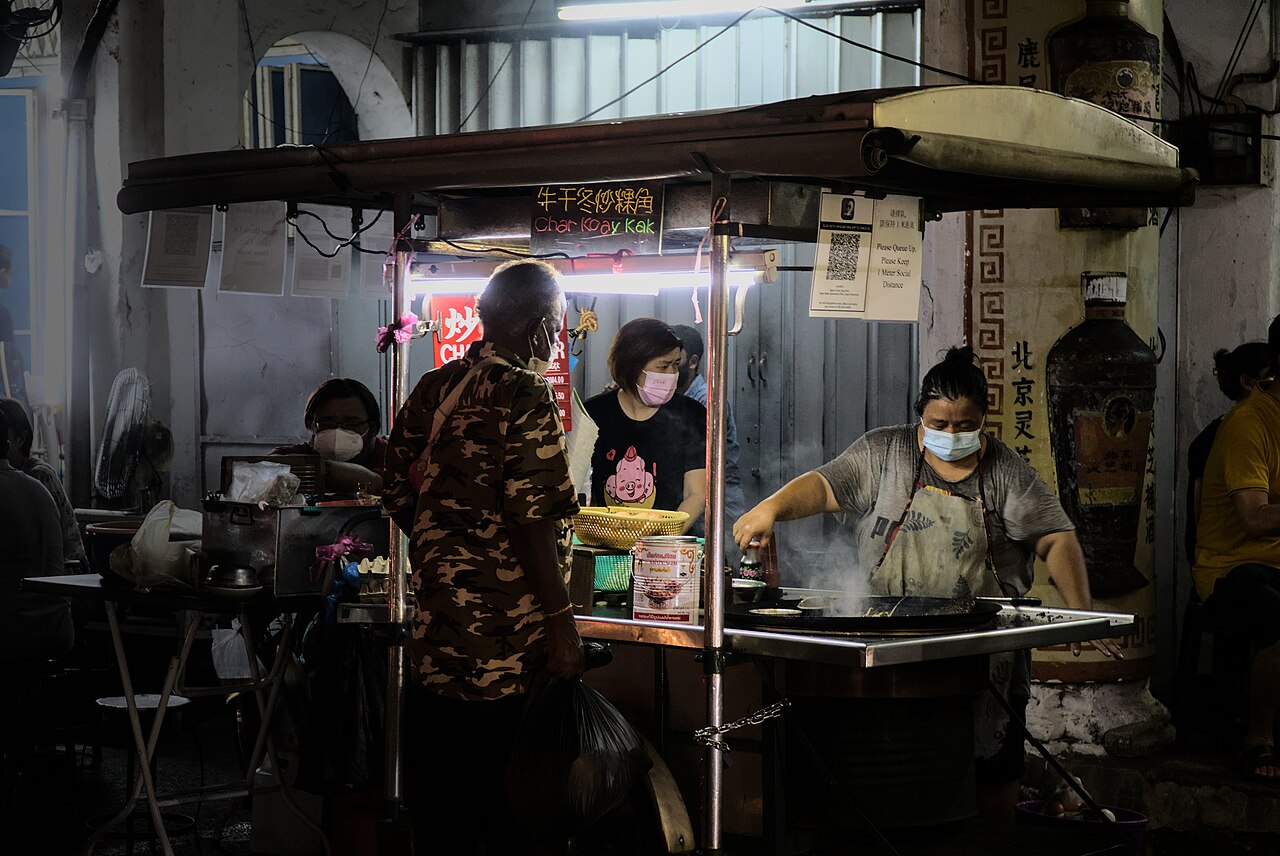
Malaysia is the one country on the Southeast Asian backpacking circuit where eating cheaply and eating well are the same activity. A full hawker meal runs RM5–15, and with a drink you are rarely over RM20. Roti canai is around RM2 plain, nasi lemak RM3–8, and char kway teow RM8–15 in Penang where it is best.
The structure to learn is the kopitiam and the hawker centre. A kopitiam is a coffee shop where several independent stalls share tables — you order from whichever stall you want, drinks come from the house, and you pay each separately. A hawker centre is the same idea at scale. Mamak stalls, run by Indian Muslim families, are open late, cheap, and where you get roti canai and teh tarik at 2am.
Two habits save real money. Eat your main meal at lunch, when nasi campur — point-and-choose rice with dishes — costs RM7–12 for a plate that would be RM25 in a restaurant at night. And drink water or teh o ais rather than bottled soft drinks. Our Malaysian street food guide covers what to order, and night markets is where the cheapest good eating happens.
Where to sleep
Dorm beds run roughly RM28–45 across the peninsula, with Cameron Highlands the cheapest at around RM28 and Kuala Lumpur the dearest at around RM45. Malaysian hostels are generally clean, air-conditioned and quieter than their Thai equivalents — the party-hostel culture is much thinner here, which is either a feature or a drawback depending on why you came.
Two places break the pattern. On the Perhentians, accommodation is limited, seasonal and correspondingly expensive: RM50–70 for a dorm bed and RM120+ for a basic beach hut, with several long-standing budget properties that are genuinely poor value. Read reviews from the current season rather than 2019. And in Borneo, wildlife lodges have no meaningful budget tier outside dormitory packages, which start around RM610 per person for three days and two nights on the Kinabatangan.
Booking a day or two ahead is enough almost everywhere. The exceptions are Chinese New Year, Hari Raya Aidilfitri and Malaysian school holidays, when domestic travel fills everything and prices climb.
Two route lengths that work
Two weeks: the spine only
Penang (4 nights) → Cameron Highlands (2) → Kuala Lumpur (3) → Melaka (2) → Johor Bahru or Singapore (2). Five stops, four bus journeys, no flights, roughly RM2,200–2,600 all in. This is the version for someone passing through Malaysia between Thailand and Indonesia, and it is a perfectly respectable fortnight.
One month: the spine plus the good detours
Langkawi (3) → Penang (4) → Cameron Highlands (2) → Kuala Lumpur (3) → Taman Negara (3) → Kota Bharu (2) → Perhentians (4) → Melaka (2) → Borneo (7). Roughly RM4,800–5,500 including one internal flight. The month is where Malaysia stops being a corridor and starts being a destination, and the two things that make it so — Taman Negara and the Perhentians — are exactly the two the fortnight cuts. See our 3 weeks in Malaysia itinerary for the detail on those detours.
How Malaysia compares on the circuit
Most people arrive in Malaysia from Thailand and leave for Indonesia or Singapore, and the comparison shapes expectations more than any guidebook does.
Against Thailand: accommodation is slightly cheaper and noticeably better maintained, food is comparable in price and arguably more varied, alcohol is roughly double, and the backpacker social scene is far thinner. There is no Malaysian equivalent of Pai or Koh Phangan. If you travel for the hostel bar, you will find Malaysia quiet. If you travel to eat and to see things, you will find it dramatically underrated.
Against Vietnam: Malaysia is more expensive per day but far easier to move around — English is widely spoken, buses run on time, and nothing requires negotiation. It is a good country to be in when you are tired of arguing about taxi fares.
Against Indonesia: Malaysia costs more for accommodation and less for transport, and the infrastructure gap is large. Getting from one end of Peninsular Malaysia to the other is a nine-hour bus ride on a good motorway; the equivalent in Indonesia is a project.
Against Singapore: not comparable. A dorm bed in Singapore costs more than a private room in Kuala Lumpur, which is why many backpackers cross the causeway for two days and come straight back.
Staying longer than you planned
The 90-day visa-free allowance for most Western nationalities is generous enough that Malaysia works as a base rather than a corridor, and a fair number of travellers who intended to pass through in ten days end up staying six weeks. Two things make that easy.
The first is that monthly rates exist almost everywhere. Guesthouses, hostels and apartment hosts in Penang, Kuala Lumpur and Ipoh routinely discount longer stays, and a private room taken by the month can land close to what you were paying for a dorm by the night. Ask directly rather than booking online — the discount is usually a conversation, not a listed rate.
The second is that Malaysian cities are genuinely liveable on a small budget. Fast, cheap internet, air conditioning, hawker food at RM8 a meal, and a public transport network that works. Penang and Kuala Lumpur both have established communities of long-stay travellers and remote workers, and Ipoh is quietly becoming a third.
What you cannot do on a tourist entry is work, including remote work for a foreign employer in any formal sense, and border runs to reset a 90-day stamp are viewed less indulgently than they once were. If you are thinking in months rather than weeks, look at the visa categories properly rather than improvising.
What to skip
- Organised tours you can do yourself. Batu Caves is a RM2.60 train ride from KL Sentral and free to enter. Half-day tours sell the same thing for RM120.
- The Penang–Langkawi ferry. It does not exist — the direct service was suspended during the pandemic and never resumed, though several backpacking guides still print a 2.5-hour crossing. Fly, or take the mainland ferry from Kuala Perlis (RM45) or Kuala Kedah (RM55).
- Genting Highlands. A casino and theme park complex in the clouds. If you want cool air, Cameron Highlands costs less and has tea.
- Paying for airport transfers. Every Malaysian airport worth landing at has a public bus or train. KLIA’s Skybus is a fraction of the KLIA Ekspres fare.
- Borneo on a two-week budget trip. The flight and the higher cost base will eat a third of your money for four rushed days. Save it for a longer trip or a dedicated one — our Borneo itinerary shows what it needs.
Practicalities
Most Western nationalities get 90 days visa-free, which is unusually generous by regional standards and means Malaysia works well as a base between shorter-stay neighbours. You must still file the free Malaysia Digital Arrival Card online within three days before arrival — visa exemption does not exempt you, and it is the most common paperwork mistake visitors make. See our Malaysia visa requirements guide.
Buy a local SIM or eSIM on arrival; data is cheap and coverage on the peninsula is excellent. Get a Touch ‘n Go card early — it works on KL’s LRT, MRT and monorail, on Komuter trains, on many buses and at every toll plaza. Carry cash: hawker stalls, jetty counters, park permit offices and small guesthouses are cash or QR only. Malaysia is a safe country for solo travel by regional standards, with petty theft and motorcycle bag-snatching the realistic risks rather than anything worse — our is Malaysia safe guide has the specifics.
One cultural note that matters more here than in Thailand: Malaysia is a majority-Muslim country and dress standards, especially on the east coast, are more conservative than the backpacker default. Shoulders and knees covered is the baseline in towns; mosques lend robes free. Kelantan and Terengganu are dry states. Our Malaysian cultural etiquette guide covers the rest.
Frequently asked questions
How many days do you need to backpack Malaysia?
Two weeks covers the west coast spine from Penang to Singapore at a reasonable pace. Three weeks adds Taman Negara and the east coast islands, which are the two things that make Malaysia worth stopping in rather than passing through. A month adds a week in Borneo. Below ten days you are transiting rather than backpacking.
Is Malaysia expensive for backpackers?
It is mid-priced for Southeast Asia — cheaper than Singapore by a wide margin, slightly cheaper than Thailand for accommodation, comparable for food and noticeably more expensive for alcohol. Budget RM120–180 a day (USD 29–43) for a realistic backpacker standard, or around RM100 a day if you are strict about dorms, hawker food and skipping the bar.
How do you get from Thailand to Malaysia overland?
Via Padang Besar, where Thai and Malaysian immigration share a station building so you clear both without leaving the platform. A shuttle train from Hat Yai runs twice daily for around 50 baht, and the KTM Komuter onward to Butterworth costs RM11.40 for 1 hour 51 minutes. Komuter tickets are walk-up only with no advance booking.
What is a realistic daily budget for Malaysia in ringgit?
RM160 a day is realistic: RM40–50 dorm, RM40 food, RM20 local transport, RM30 activities, RM20 drinks, RM10 tourism tax. Frugal travellers manage RM83–100 by staying in cheaper towns, eating nasi campur at lunch and not drinking. Intercity buses and trains sit on top, at roughly RM300–500 for a three-week peninsula route.
Do foreigners pay a tourist tax in Malaysia?
Yes. Foreign passport holders pay RM10 per room per night at licensed accommodation, charged per room rather than per person, with Malaysians and permanent residents exempt. Sabah and Sarawak apply their own state levies at a similar effective rate. Over a month it adds up to about RM300.
Can you travel Malaysia by bus and train only?
Across the peninsula, entirely. The bus network reaches everywhere, the ETS train covers the west coast spine, and the Jungle Railway crosses the interior overnight from around RM34. The only places that require a flight are Langkawi — since the Penang ferry stopped running — and anywhere in Borneo.
Is Malaysia safe for solo backpackers?
Yes, by regional and global standards. Violent crime against travellers is rare, English is widely spoken, and the transport network is reliable. The realistic risks are petty theft in crowded areas, motorcycle bag-snatching in parts of KL and Penang, and dengue. Solo female travellers generally report Malaysia as comfortable, with more conservative dress advisable on the east coast.
Where to go from here
If your route is fixed at a fortnight, our 2 weeks in Malaysia itinerary covers the same ground at a slightly higher comfort level. If you are chaining islands, island hopping itineraries works out the seasonal logic. And if Borneo is calling despite the budget, our Borneo itinerary is honest about what the cheapest workable version costs.