Malaysian Street Food: Where to Find the Best Hawker Stalls (2026)
Your complete guide to Malaysian street food, from Penang's legendary hawker centers and KL's bustling night markets to mamak stalls, Ipoh's hidden gems, and Borneo's unique flavors.

Pull up a plastic stool at a hawker centre in George Town, order a plate of char kway teow from someone who has cooked nothing else for thirty years, and you start to understand why Malaysians treat eating as a national sport. Street food here isn’t a budget fallback or a tourist novelty. It’s where the whole country actually eats, three times a day, across every income bracket and every culture that calls Malaysia home. Chinese, Malay, Indian, and the Peranakan blends in between all crowd onto the same menu, and often the same street.
This guide is built around where to find the best of it: the hawker centres and night markets that genuinely matter in Penang, Kuala Lumpur, Ipoh, Malacca, Johor Bahru, and Kuching, plus what to order at each, how the ordering actually works, and what it costs. If you want a closer look at the dishes themselves, our roundup of must try Malaysian food goes deeper on each one, while our guide to Malaysian food by region maps how the flavours shift as you travel from the peninsula to Borneo.

Understanding Malaysian Hawker Culture
Before you eat, it helps to know how a hawker centre actually works, because it isn’t quite like a food court anywhere else. Picture an open-air or semi-covered hall ringed by dozens of independent stalls, all sharing one big pool of tables in the middle. Each stall does one or two things and nothing else: this one only fries char kway teow, that one only ladles laksa. Plenty have been run by the same family for two or three generations, the recipe tightened a little more each year.
Here’s the part that trips up first-timers. You don’t queue at a counter and carry a tray. You grab a table first, then walk over to whichever stalls you fancy and order from each one, telling them your table number. The food comes to you, stall by stall, and you pay each cook separately as it arrives. Want noodles from one stall, satay from another, and a cendol to finish? Order all three at once and they’ll sort themselves out.
The hawker centre is also a living room for the neighbourhood. Families share dinner, friends nurse a late supper, and deals get done over kopi and roti canai. Lean into that communal side rather than treating it as a quick refuel, and the meal tends to become one of the things you remember most about the trip.
Penang: The Street Food Capital of Malaysia
Ask Malaysians where the food is best and most will grudgingly admit it’s Penang, even if their hometown comes a close second. The island stacks Hokkien, Teochew, Malay, Indian Muslim, and Nyonya cooking on top of each other in a way you won’t find replicated with the same depth anywhere else. George Town’s hawker culture sits inside a UNESCO-listed core, and the reputation pulls in eaters from across the region. We cover the island in far more detail in our dedicated Penang food guide, but here are the spots that should anchor any first visit.
Gurney Drive Hawker Centre
Gurney Drive is the name everyone knows, a sprawl of roughly a hundred stalls strung along the seafront promenade. It’s where you sample char kway teow seared over a charcoal flame, asam laksa with its tangy fish broth, and Hokkien mee built on a deep prawn-shell stock. The kitchen hours run from late afternoon into the night, and the mix of sea breeze and sizzling woks is about as Penang as it gets. Dinner peaks hard between 7 and 9 PM, so come early if you want a decent table.
New Lane Hawker Centre
Locals call it Lorong Baru, and every afternoon around 4 PM the street closes to traffic and fills with stalls and plastic stools instead. This is Penang hawker food at its most atmospheric, with cooks lined up down both sides of the road. The char kway teow has a serious following, and the oh chien oyster omelettes rank among the best on the island. Tourists and locals pack in together, and the open-air, end-of-street energy is exactly what you came for.
Cecil Street Market and Kimberley Street
Cecil Street Market near Komtar is a local favourite for breakfast and lunch, especially the duck kway teow soup, its broth sweet and rich from years of practice. A few blocks over, Kimberley Street earns its own pilgrimage for char kway teow, koay chiap duck noodle soup, and a deep bench of Hokkien and Teochew dishes that run from early morning to late at night.
Jelutong and Air Itam
To eat where the tour groups don’t, head for Jelutong, an old neighbourhood whose wet markets turn into hawker paradises at breakfast and again at dusk. Long-running stalls turn out Hokkien mee, char koay kak fried radish cake, wan tan mee, economy bee hoon, Indian thosai, and apam balik. Up the hill, Air Itam Market is laksa country, with several stalls quietly arguing over who makes the island’s best asam laksa, and most locals will tell you it beats anything on the tourist trail.
What to Eat in Penang
Work your way through the essentials: charcoal-fried char kway teow, sour-and-savoury asam laksa, Hokkien mee prawn noodle soup, cendol drowned in shaved ice and gula melaka, nasi kandar from the original Penang shops, oh chien oyster omelette, rojak in its thick prawn-paste sauce, chee cheong fun rice noodle rolls, and curry mee in a coconut-rich broth. Most plates land between RM5 and RM12, which is a big part of why Penang stays one of the most affordable eating cities in Southeast Asia.
Kuala Lumpur: A Street Food Metropolis
Kuala Lumpur eats like the crossroads it is. Malay, Chinese, Indian, and mamak stalls pile up into something vast and a little chaotic, and the city barely stops: dim sum at dawn, mamak roti past midnight. Our Kuala Lumpur food guide breaks the neighbourhoods down stall by stall, but these are the corners worth building an evening around.
Jalan Alor

Jalan Alor is KL’s most famous food street, and yes, every visitor ends up here for good reason. Tucked behind the lights of Bukit Bintang, it wakes up each evening as restaurants and stalls drag tables into the road and the air thickens with grilling satay, screaming woks, and barbecued seafood. Chinese, Malay, Thai, and outright fusion stalls jostle for your attention. Go for grilled chicken wings, Hokkien mee, claypot chicken rice, and a fresh fruit juice. Prices run a touch above a neighbourhood hawker centre because of the location, but the sheer choice and buzz earn it.
Petaling Street and Chinatown
Petaling Street in Chinatown is the other KL classic, where street vendors plate up some of the city’s best Chinese food. Come in the morning for dim sum; stay for Hokkien mee, curry noodles, and wonton mee through the day. Don’t skip Madras Lane, the narrow alley running alongside, where decades-old stalls serve yong tau foo, curry laksa, and chee cheong fun that locals line up for daily.
Kampung Baru
Kampung Baru is the old Malay village holding its ground in the middle of the city, and it’s the place for Malay home cooking out on the street. The Saturday night market is the headline act, stacked with nasi lemak, ayam percik, keropok lekor, kuih, and a dozen other traditional plates. Even on a quiet weeknight, the stalls along Jalan Raja Muda Musa turn out excellent nasi campur, rendang, and satay in a neighbourhood that feels a world away from the towers glinting overhead.
Bangsar and SS2
Bangsar has turned into one of KL’s trendier eating districts, mixing old-school hawker stalls with newer street-food concepts; the Sunday pasar malam is packed with local favourites. Across in Petaling Jaya, SS2 is a hawker institution known for wanton mee, pan mee, and the late-night muruku and roti canai stalls that feed the after-midnight crowd.
What to Eat in KL
Hit the roadside nasi lemak stalls first, then chase down Hokkien mee in its thick dark sauce, pan mee with hand-torn noodles, chili pan mee dusted in dried chili flakes, Kajang-style satay, banana leaf rice at an Indian restaurant, charcoal claypot chicken rice, roti canai at a mamak, and a bowl of bak kut teh herbal pork rib soup. Budget around RM8 to RM15 a dish at most hawker centres, with mamak joints offering some of the best value in the city.
Ipoh: The Underrated Food City
Plenty of Malaysian food obsessives will quietly tell you Ipoh out-eats Penang, and they’re not joking. The Perak capital builds its reputation on a handful of specialities that are either unique to the city or simply done better here than anywhere else.
Famous Ipoh Street Food
Start with Ipoh white coffee, the city’s most famous export, beans roasted with palm-oil margarine for a creamy, fragrant sweetness; the original Old Town shops are worth the detour on their own. Then there’s bean sprout chicken, the signature plate: silky poached chicken alongside fat, crunchy bean sprouts grown in the mineral-rich water that runs off Ipoh’s limestone hills. Tender chicken, crisp sprouts, fragrant rice — it sounds plain on paper and tastes like anything but.
Ipoh hor fun, flat rice noodles in a clear chicken-and-prawn broth, is the other must-order, the noodles famously silky thanks to the city’s soft water. Round it out with salt-baked chicken, tau fu fah soybean pudding, caramel custard egg tart, and dim sum at the legendary Foh San, where regulars start queuing not long after sunrise.
Where to Eat in Ipoh
The densest eating is in Ipoh Old Town, especially along Jalan Bandar Timah and at the Thean Chun coffee shop. The new town around Jalan Pasir Puteh holds its own too, and the morning market at Pasar Besar is worth wandering for the sheer sensory overload of fresh produce and cooked-food stalls working side by side.
Malacca: Nyonya and Heritage Street Food
Malacca eats the way it was built, layer over layer. Centuries as a trading port left the city with dishes that fold together Malay, Chinese, Indian, Portuguese, and Dutch influences, and its Nyonya (Peranakan) cooking — Chinese technique married to Malay spice — is the headline contribution.
Jonker Street Night Market
Every Friday and Saturday night, Jonker Street in the old Chinatown turns into a full-blown night market, stalls down both sides selling chicken rice balls, coconut shakes, satay celup, and trays of Nyonya kuih. It’s as much street theatre as dinner, with live music, souvenir hawkers, and a festival hum that pulls in locals and visitors alike.
Essential Malacca Street Food
Chicken rice balls are the city’s signature, Hainanese chicken rice rolled into little round balls instead of scooped onto a plate. Satay celup is the communal one to try: skewers of meat, seafood, and vegetables dunked into a shared pot of bubbling peanut satay sauce. Leave room for Nyonya laksa, cendol from the famous Klebang stalls, Portuguese grilled fish out at the Medan Portugis settlement, and a fresh popiah.
Johor Bahru: Southern Flavors
Down at the southern tip of the peninsula, a causeway from Singapore, Johor Bahru has grown a street food scene that pulls eaters from both sides of the border, trading on Singapore-adjacent quality at firmly Malaysian prices.
JB Hawker Highlights
Restoran Lai Kee is the old-school institution, famous for fishballs handmade from ikan parang and little more than a pinch of salt. Din Kee Beef Noodle has been ladling rich beef noodles since 2007. The Pasar Karat flea market wakes up at night with a food section selling mee rebus, rojak, murtabak, and southern specialities, while the seafood stalls along Danga Bay grill fish, fire up sambal prawns, and crack butter crabs for noticeably less than you’d pay across the strait.
Kuching: Borneo Street Food
Kuching, the Sarawak capital over on Borneo, eats unlike anywhere on the peninsula, leaning on indigenous ingredients and East Malaysian cooking traditions you simply won’t meet in KL.
Top Spot Food Court
Top Spot is Kuching’s signature, a rooftop food court where seafood stalls go head to head on freshness and price. The grilled fish, butter prawns, and stir-fried midin fern are the orders to make, and the open-air perch over the city doesn’t hurt.
Essential Kuching Street Food
Sarawak laksa is the one to chase, a tangle of coconut milk, sambal belacan, and sour tamarind in a broth complex enough to have won over the late Anthony Bourdain. Kolo mee is the everyday champion: springy egg noodles tossed with lard, soy, and vinegar, crowned with char siu and minced pork. Push further into ayam pansuh chicken cooked inside bamboo, umai raw-fish salad, and the layered three-layer tea that’s a Kuching trademark.
The Mamak Experience
You can’t talk about eating in Malaysia without the mamak. These Indian Muslim eateries are one of the load-bearing pillars of the country’s food life, found in every city, town, and kampung, plenty of them open around the clock, and they double as the default meeting point for Malaysians of every background.
What Makes Mamak Special
Nowhere is Malaysia’s mix more visible than at a mamak, where every race and income bracket ends up at neighbouring tables over roti canai and teh tarik. The food is cheap, reliably good, and there whenever you want it. On a big football night, the place becomes an open-air viewing party, big screen and all.
Essential Mamak Dishes
Roti canai is the anchor, a flaky flatbread torn into dhal, fish curry, or chicken curry. Teh tarik, the frothy pulled tea cut with condensed milk, is the drink to match it. From there it’s mee goreng mamak, nasi goreng, maggi goreng fried instant noodles, stuffed murtabak, and nasi kandar. For a late, sweet finish, order roti tissue towering over the plate with condensed milk, or a roti bom.
Night Markets: The Pasar Malam Experience
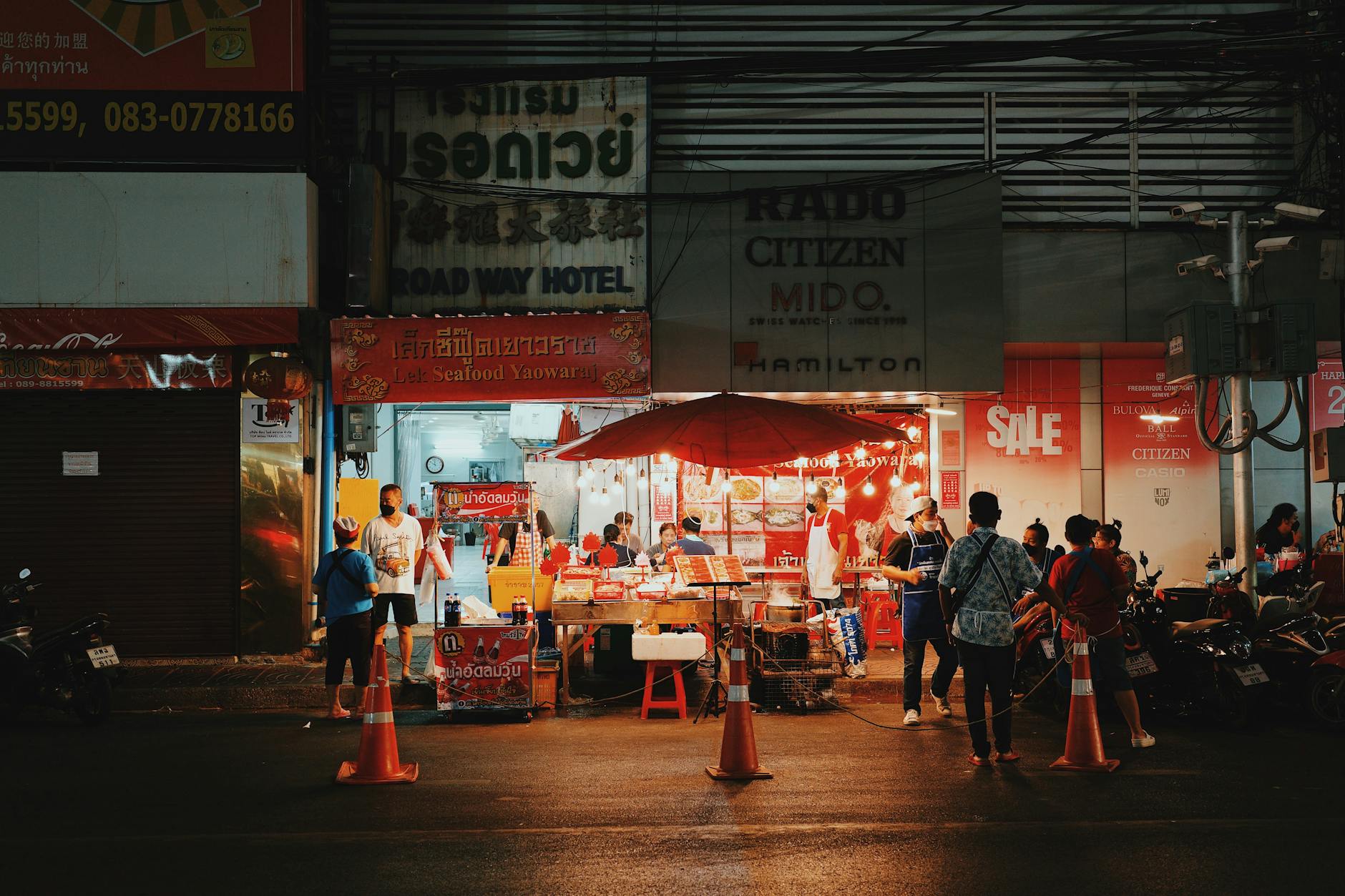
The pasar malam, Malaysia’s weekly night market, is where an ordinary street or car park turns into an open-air food festival for one evening. Most neighbourhoods get their own on a set night, and locals genuinely plan the week’s eating around them.
How Night Markets Work
Stalls start setting up around 4 to 5 PM and hit full stride by 6 or 7, winding down near 10 or 11. You’ll find cooked food alongside fresh fruit, snacks, clothes, and household odds and ends, but the food run is always the main event, from grilled meats and fried snacks to full meals and a wall of desserts.
Famous Night Markets
Taman Connaught in KL is one of the biggest in the country, running close to two kilometres with hundreds of stalls; it takes over Wednesday evenings and draws a serious crowd. The Jalan TAR market near Masjid India is the spot for Indian Muslim street food on Saturday nights. Over in Penang, the Batu Ferringhi night market leans tourist, mixing local hawker plates with souvenir stalls.
Must-Try Night Market Foods
Graze widely: ayam percik grilled chicken basted in coconut sauce, the Ramly burger (Malaysia’s egg-wrapped take on the patty), keropok lekor fish crackers, lok lok skewers cooked in boiling broth, apam balik peanut pancakes, buttered grilled corn, fried chicken wings, and an endless parade of kuih, the traditional cakes and pastries you’ll never quite finish working through.
Street Food Prices and Budget Guide
The other thing street food has going for it is the maths. Malaysia ranks among the cheapest places in the world to eat well, and the hawker stall is where your ringgit stretches furthest.
Typical hawker centre prices run RM5 to RM15 a dish, with drinks at RM2 to RM5. A proper meal plus a drink lands somewhere between RM8 and RM18. Night market snacks go cheaper still, plenty of them in the RM2 to RM8 range.
A daily food budget built around hawker centres and night markets sits at roughly RM35 to RM60. A normal day might look like roti canai and teh tarik for breakfast (RM5), a noodle or rice lunch with a drink (RM12), a pisang goreng or curry puff in the afternoon (RM3), and a night market dinner (RM15).
Mamak restaurants are the value champions: roti canai around RM1.50 to RM2.50, teh tarik about RM2, and a full plate of nasi kandar or mee goreng for RM7 to RM12.
Hawker Center Etiquette and Tips
A little local know-how goes a long way at a hawker centre, both for your own sake and for the nods of approval from the table next to you.
Finding and Reserving a Table
Learn the tissue-packet trick. When a place is slammed, a packet of tissues left on a table means it’s taken, and the system runs entirely on trust that everyone honours. Don’t abuse it: claim a table and then wander off for fifteen minutes before ordering and you’ve crossed a line. When it’s truly heaving, sharing a table with strangers is normal, so don’t be shy about asking to take the empty seats at someone else’s table.
Ordering and Payment
Walk up to the stall, order, and give your table number; some tables have numbered markers, at others you’ll just describe where you’re sitting. Order from as many stalls as you like and each delivers separately. You usually pay when the food arrives, though a few stalls want cash up front. And it is cash: card payment is still rare at traditional hawker stalls, so keep small notes on you.
General Tips for Tourists
Follow the queues; the stall with the long line is long for a reason. Eat at peak times, when stalls are cooking in fast-moving batches and everything’s fresh. Pack your own tissues or wet wipes, since not every centre provides them. Be patient when it’s busy, because good hawker food is made to order, not held under a heat lamp. And learn two words, terima kasih (thank you) and sedap (delicious); both earn you a grin from whoever just fed you.
Food Safety at Hawker Centers
For the vast majority of visitors, Malaysian street food causes no trouble at all, and most people eat at hawker centres happily for the entire trip. Stick to stalls with high turnover, where the food is constantly being cooked fresh, and steer clear of anything that’s been sitting out at room temperature for a while. If you’re cautious about hygiene, stick to bottled water, though the ice at established centres is commercially made and safe. Got a sensitive stomach? Start with hot, cooked dishes and ease into raw items like rojak once your system has settled into the local food.
Best Time for Street Food in Malaysia
Street food runs on a daily clock worth knowing. Breakfast stalls firing out roti canai, nasi lemak, dim sum, and kopi open as early as 6 AM and trade through mid-morning. The lunch rush hits between 11:30 AM and 1:30 PM. Things wake up again around 5 PM, with night markets and dinner stalls peaking from 7 to 9. And the mamak, of course, never really closes, which is why it’s the answer to every after-midnight craving.
If you can time it, the best eating lines up with the festivals. Ramadan bazaars during the fasting month lay out staggering spreads of Malay food and dishes you’ll only see for those few weeks. Chinese New Year brings its own special hawker plates and markets, while Deepavali and Thaipusam fire up Indian stalls cooking elaborate festival food.
Final Thoughts
Eating your way through Malaysia is cheap and delicious, but that’s almost beside the point. The hawker stall is where the country’s many cultures actually sit down together, and the food carries all of that history on a RM8 plate. Whether you’re elbowing in at a Penang hawker centre, drifting down a KL night market, hunting Ipoh’s quiet specialities, or cracking open Sarawak laksa in Kuching, the odds are good you’ll be planning your next trip back before the flight home has even boarded.