Malaysian Arts & Crafts: Batik, Pewter, Songket & Where to Make Your Own (2026)
Most handicrafts sold to visitors are machine-printed at handmade prices, and you can tell in four seconds. A buying guide, an authentication test and workshops with real prices.
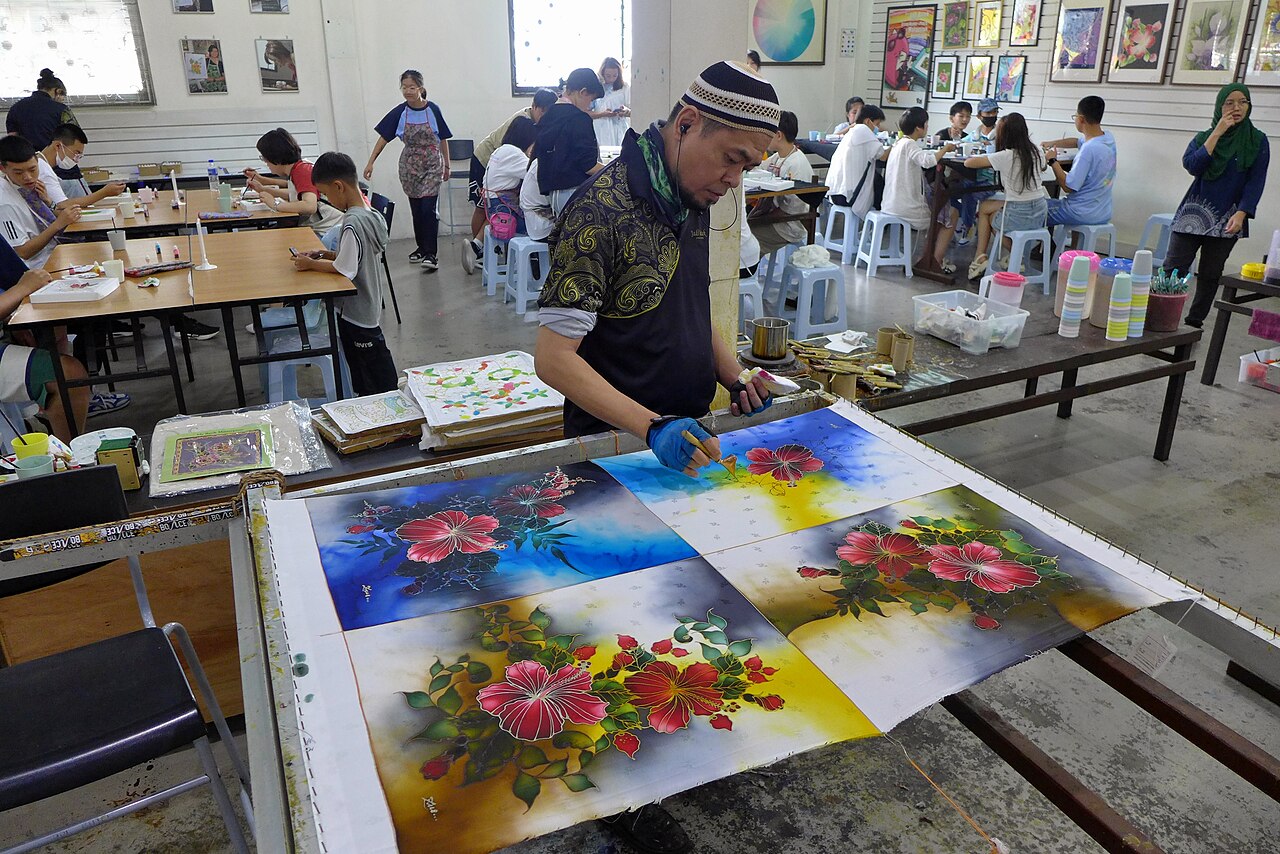
Turn the cloth over. That is the test, and it takes four seconds. If the pattern on the back of a batik sarong is nearly as sharp and as saturated as the pattern on the front, dye went through the fabric and someone waxed it by hand. If the back is pale, blurry, or plainly white where the front is coloured, you are holding a screen print that was made in a factory and priced like an heirloom. Most of the Malaysian arts and crafts sold to visitors fail that test, and almost nobody tells you to run it.
This is a buying guide and a making guide, not a museum catalogue. The buying half tells you what each craft should cost, the price floor below which handmade is arithmetically impossible, and four physical tests you can run in the shop with the thing still in your hands. The making half tells you where to sit down at a wax pen or a pewter hammer, what it costs, how long it takes, and whether the minimum age rules you out.
The price floor matters because of labour time. A metre of hand-drawn batik tulis is days of work with a copper-spouted canting pen; a songket panel can hold a weaver at the loom for weeks. When a stall offers either for RM 15 (about US$4), the only question is which factory printed it. None of this argues against buying cheap printed cloth. It argues against paying handmade prices for it, which is what happens to most visitors in the airport shop on the way home.
| Craft | Home region | Honest price range | Can you make one? |
|---|---|---|---|
| Batik (tulis / cap) | Kelantan, Terengganu | RM 150-800 tulis; RM 60-200 cap | Yes |
| Songket | Terengganu, Kelantan | RM 269 to RM 6,000+ | Demonstrations only |
| Pewter | Selangor | RM 90-500 small piece | Yes — RM 75 or RM 180 |
| Labu sayong pottery | Kuala Kangsar, Perak | RM 40-250 by size | At the kilns |
| Pua kumbu | Sarawak (Iban) | Hundreds to thousands | Kuching demos |
| Kasut manek beadwork | Melaka, Penang | RM 400+ a pair | Irregular courses |
| Wau kites | Kelantan | RM 20-150 by size | Yes, at Kota Bharu workshops |
| Wayang kulit puppets | Kelantan | RM 450-600+ carved | Tumpat workshops |
| Mengkuang / pandan weaving | East coast, Sarawak | RM 15-120 bags, mats | Ad hoc |
| Mah Meri & Jah Hut carving | Selangor, Pahang | RM 150-1,000+ | Demonstrations only |
The four-second test: how to tell real from printed
Every shop assistant will tell you the stock is handmade, and almost none are lying deliberately — the word has drifted to mean “made in a workshop where a person operated a machine”. You need physical tests, not assurances. Run these four in order.
Test 1 — the reverse-side dye test
Wax-resist batik is dyed, not printed. The dye bath soaks the cloth through, so the design appears on both faces at almost equal strength. Hold the piece up, flip it, compare. On genuine batik the reverse is perhaps ten per cent softer than the front and no more; every line, dot and colour boundary stays legible. On a printed imitation the reverse shows a ghost at best, often nothing but base cloth with a faint bleed at the edges of dark areas. This one test disqualifies most of what is stacked on tourist market tables, and it works in bad light and in a hurry.
Test 2 — the stretch test
Take a small area between both hands and pull gently until the weave opens. Printed cloth shows white threads in the gaps, because pigment sat on the surface and never reached the fibre core. Dyed cloth stays coloured right into the weave. Do this on a dark part of the design where contrast is clearest, and be gentle — you are testing the cloth, not stress-testing someone’s stock. Our guide to Malaysian cultural etiquette applies in craft shops too: ask first, use your right hand, and do not haggle hard over work you were just told took three weeks.
Test 3 — the motif-repeat test
This test separates the two grades of genuine batik from each other, which is where you learn what you are paying for. Lay the piece flat, find a motif that occurs several times, and look at the copies rather than the original.
- Batik tulis (hand-drawn): no two motifs are identical. Line thickness varies where the canting ran hot or cool, there are small wax bleeds, a wandering outline, dots not quite where the pattern says. Not defects — the signature of a hand.
- Batik cap (hand-stamped): the motif repeats because a copper block made it, but each impression lands fractionally differently: a hair of rotation, a heavier press, a join line between stamps that does not align. Look at the seams between repeats.
- Machine print: the repeat is mathematically exact, every instance in register with every other, edges uniformly crisp with no wax bleed. A repeat interval that never varies means printed fabric.
Test 4 — smell and hand
Hand-waxed cloth often keeps a faint waxy smell for months, especially in the folds, and has a slightly stiffer hand than printed cotton of the same weight. It is the least reliable test alone — year-old stock loses the scent — but as a tiebreaker after the first three it is worth ten seconds.
What it should cost — and the floor where the arithmetic stops working
Price is evidence. A craft that takes a skilled person three days cannot sell for the price of a restaurant meal, whatever the label says. The table gives the range to expect and, more usefully, the point below which the arithmetic stops working. To be clear about what that second column is: it is not a published figure and no trade body issues one. It is our own rule of thumb, reasoned back from loom and canting hours and from the raw cost of silk, gold thread and tin. Treat it as a prompt to ask harder questions, not as a test that settles the matter.
| Item | Genuine handmade range | Rule-of-thumb floor | Why |
|---|---|---|---|
| Batik tulis sarong (2m) | RM 250-800 (US$60-190) | RM 150 (US$36) | Days of canting work |
| Batik cap sarong (2m) | RM 80-200 (US$19-48) | RM 60 (US$14) | Hand-stamped, bath-dyed |
| Batik scarf, hand-painted silk | RM 200-400 (US$48-95) | RM 120 (US$29) | Silk cost sets the floor |
| Songket, cotton, handwoven | RM 1,000-1,500 (US$240-360) | RM 269 (US$64) | Weeks at the loom |
| Songket, silk, handwoven | RM 5,000-6,000 (US$1,190-1,430) | RM 1,690 (US$400) | Silk plus gold weft |
| Pewter, small dish or tankard | RM 90-500 (US$21-119) | RM 60 (US$14) | 92-97% tin has a metal cost |
| Wau kite, large | RM 100-150+ (US$24-36) | RM 60 (US$14) | Split bamboo, cut-paper inlay |
| Wayang kulit puppet, carved | RM 450-600+ (US$107-143) | RM 200 (US$48) | Punched hide, articulated |
| Kasut manek beaded shoes | RM 400+ (US$95+) | RM 250 (US$60) | Thousands of beads, hand-sewn |
| Mengkuang bag, woven pandan | RM 40-120 (US$10-29) | RM 25 (US$6) | Leaf cut, dried, dyed, split |
The songket rows need a caveat: the silk figures, quoted around RM 5,000 to RM 6,000 for a handwoven piece and from about RM 7,500 for Sutera Terengganu silk, come from vendors and gallery listings rather than any published index, so treat them as asking prices. The direction of travel is not in doubt — loom time cannot be compressed. Our breakdown of daily costs in Malaysia puts a four-figure textile against what you are spending on everything else.
Craft by craft: what each one is and where it comes from
Batik — three grades, three prices
Malaysian batik favours larger, looser floral and leaf motifs and avoids figurative human and animal imagery, which is what most obviously separates it from the denser geometric filling of Javanese court batik. Kelantan and Terengganu are the heartland; Penang has a factory tradition at Teluk Bahang, and Kuala Lumpur has the galleries that will let you make your own.
Grade matters more than region. Batik tulis is drawn freehand with a canting, a small copper reservoir with a spout that lays a line of hot wax. Batik cap is stamped with a copper block — faster, more regular, still genuinely resist-dyed. Machine-printed “batik” is a printed textile borrowing the name. All three are sold here; only the first two are craft, and only one is worth several hundred ringgit.
Songket — UNESCO-listed and genuinely expensive
Songket floats metallic thread across a silk or cotton ground as a supplementary weft, building raised gold and silver patterning. UNESCO inscribed it on the Representative List of the Intangible Cultural Heritage of Humanity in 2021. The weaving villages cluster around Kuala Terengganu — Pulau Duyong and Chendering — and Kampung Penambang in Kelantan; the Kuala Terengganu and east coast guide covers how to reach them. Retail handmade series start around RM 269 (about US$64) and reach roughly RM 1,690 (US$400); handwoven cotton is quoted at RM 1,000-1,500 and silk from about RM 5,000 up. Noor Arfa Craft Complex in Kuala Terengganu is the easiest single stop and runs try-it batik.
Pewter — and the mistake a page-one competitor keeps making
Malaysian pewter is a Selangor story, not a Borneo one. Pewter is a tin alloy, and the industry exists because of the nineteenth-century tin mines of Selangor and the Kinta Valley. More than one well-ranked article credits Sabah or Sarawak. The geology disagrees.
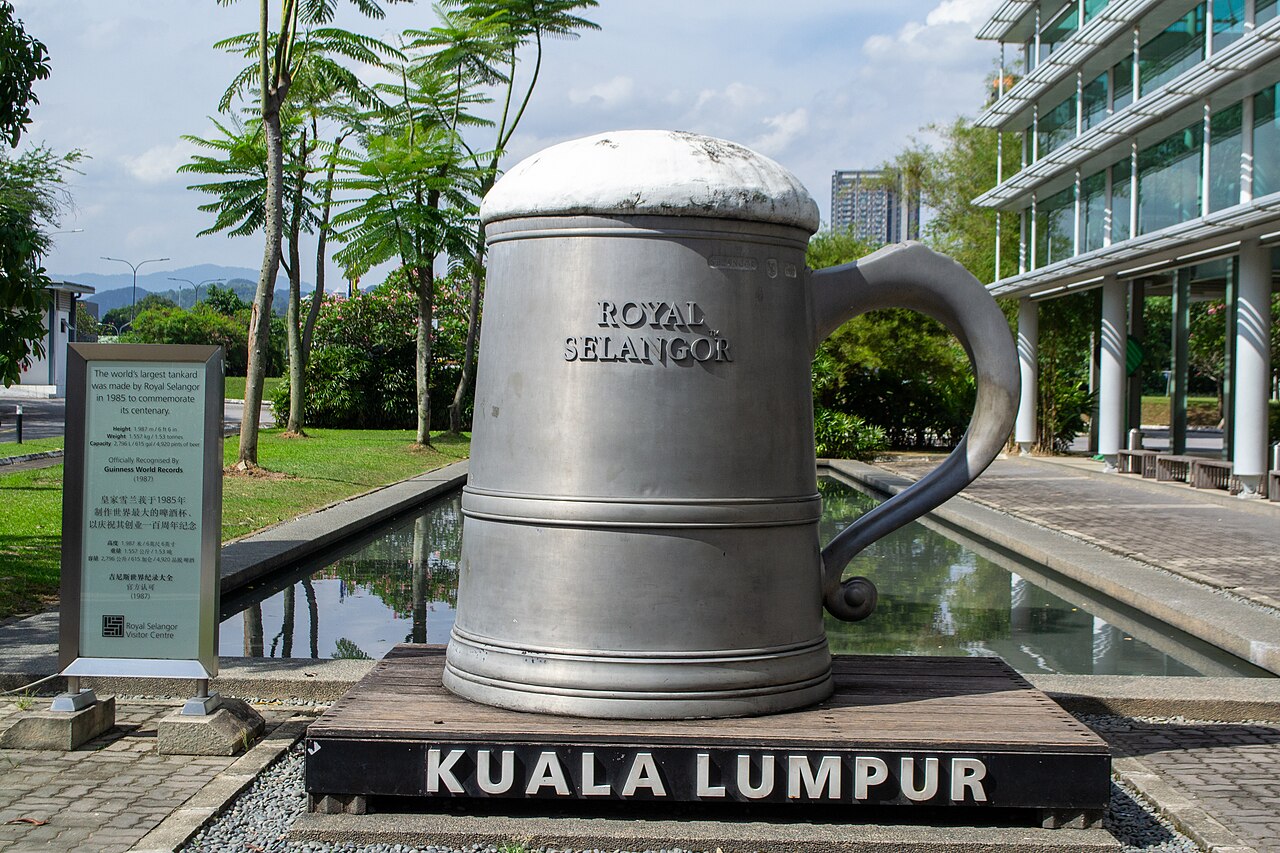
Royal Selangor pewter runs 92 to 97 per cent tin, the highest international pewter standard rather than a marketing line. The Visitor Centre at 4 Jalan Usahawan 6, Setapak Jaya, 53300 Kuala Lumpur is free to enter, open 09:00-17:00 daily including public holidays, with free parking and a free shuttle van from selected pickup points. Inside are the Comyns Archive of more than 35,000 artefacts and a Petronas Twin Towers replica built from over 7,000 tankards. Nearest station is LRT Wangsa Maju on the Kelana Jaya line, about five minutes away. Free admission puts it on any list of free things to do in Malaysia.
Labu sayong, pua kumbu and kasut manek
Labu sayong is the gourd-shaped Perak water vessel from Kuala Kangsar, fired then smoked with rice husk for its matt black surface. Water kept in one stays cool, which is the point of the design. Hand-shaped pieces are never quite symmetrical; expect RM 40-250 (about US$10-60). A uniform, plasticky black came from paint, not smoke.
Pua kumbu is Iban warp ikat from Sarawak, tied and dyed before weaving, historically ceremonial rather than decorative. The Tun Jugah Foundation, Level 4, Tun Jugah, 18 Jalan Tunku Abdul Rahman, 93100 Kuching, holds a major collection, runs weaving demonstrations, and states that 100 per cent of a textile’s sale price goes to the weaver. Slot it into a day using the Kuching city guide.
Kasut manek are Straits Chinese slippers sewn from thousands of glass beads over weeks — context in our guide to Peranakan heritage. Turn one over: hand-sewn beadwork shows thread paths and uneven spacing, machine work sits in perfect rows and is often glued in patches. Under about RM 250 (US$60) a pair, it is not hand-beaded.
Wau, wayang kulit and mengkuang
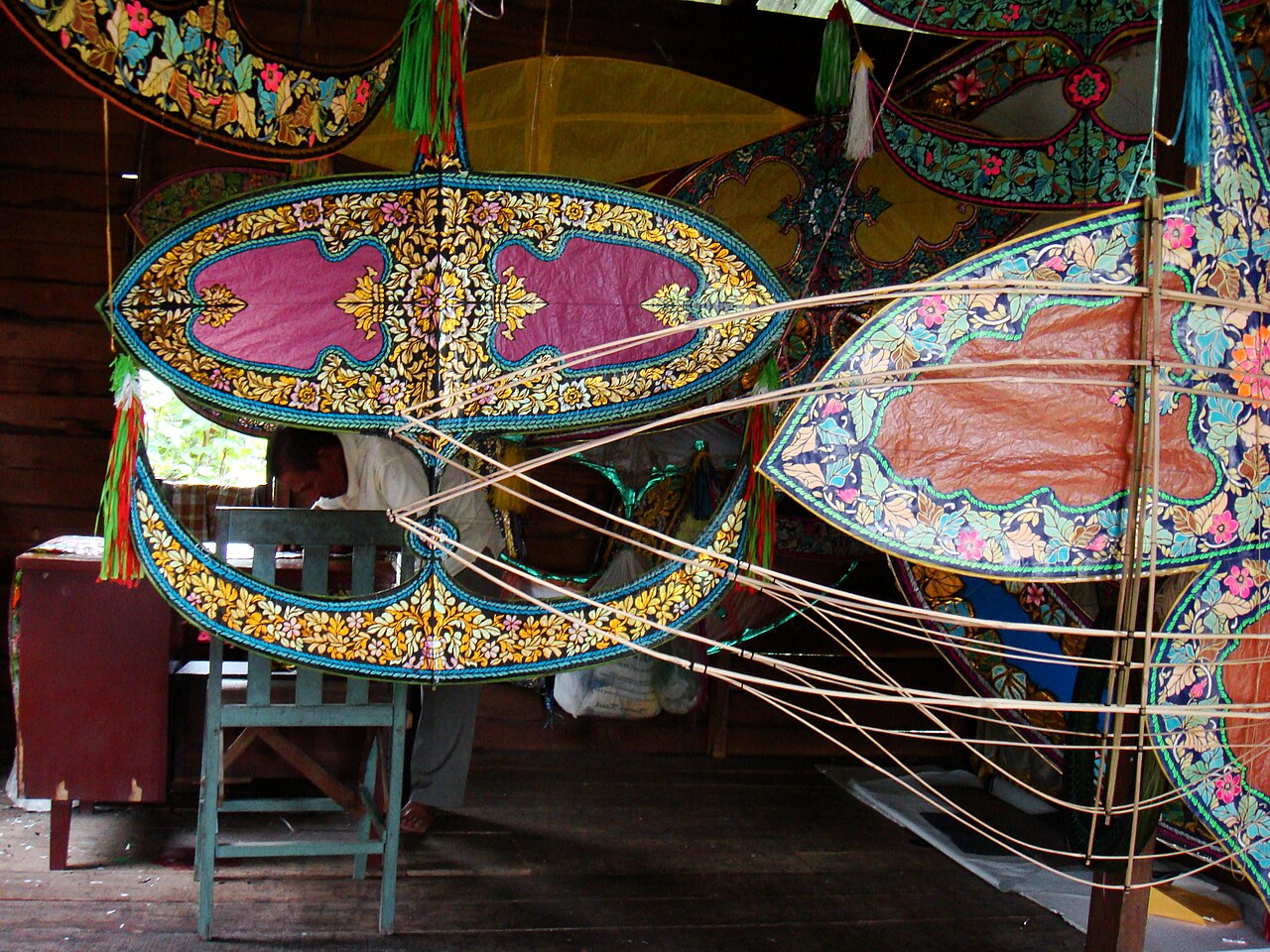
The wau is a split-bamboo kite skinned in layered cut paper, and in Kelantan it reaches a size that makes it structural. Galeri Wau Pak Sapie & Sons on Jalan Pantai Cahaya Bulan, 15350 Kota Bharu opens 08:00-17:00, with kites for sale plus workshop space. Indicative 2024 pricing, now approximate: small RM 20-50, medium RM 50-100, large RM 100-150 or more. Good frames are shaved to a taper and lashed, not stapled.
Wayang kulit Melayu is a listed national heritage item; the puppets are punched and carved from hide, articulated and painted. Galeri Wayang Kulit Melayu Tradisional Kelantan at Simpang Tiga Morak, Palekbang, Tumpat hosts performances, exhibitions and workshops. Carved puppets ran around RM 450-600 and up in 2024; one at RM 200 is a thin-hide copy with printed detail. Hold it to a light — that is what it was made for.
Mengkuang is screwpine leaf, cut, de-thorned, dried, dyed and split before weaving starts, which is why a RM 15 (about US$4) “woven” bag is usually plastic raffia. Real mengkuang feels dry and faintly waxy and has edges folded and tucked rather than heat-sealed. Genuine baskets sell beside the fish and vegetables, not in souvenir shops — see our guide to Malaysia’s night and food markets.
Woodcarving and the sape
Two Orang Asli groups produce the country’s most collected woodcarving: the Mah Meri of coastal Selangor, whose spirit masks are cut largely from nyireh batu hardwood, and the Jah Hut of Pahang, whose bes figures depict named illness spirits. The iconography is specific, not generic. Prices run from around RM 150 for a small figure to well over RM 1,000 (US$36 to US$240+). Read the background in our overview of Malaysia’s indigenous peoples before you negotiate, because knowing what a figure represents changes what it is worth to you.
The sape is the boat-shaped Orang Ulu lute of Sarawak, carved from a single block of wood. A playable instrument is a serious purchase; the small decorative sape in gift shops is a carving, not an instrument, and should be priced as one. Borneo also gives you Rungus beadwork in Sabah and Iban basketry along the Kuching waterfront — the wider list of things to do across Malaysia shows how craft stops slot around the parks without wasting a transfer.
Where to make your own: the workshop comparison
Making one is cheaper than buying one and teaches you more about authentication than any amount of reading — an hour with a wax pen shows you exactly why hand-drawn lines wobble. Here is what is bookable, what it costs and who is allowed in.
| Venue | City | Craft | Price (MYR) | Duration | Minimum age | What you take home |
|---|---|---|---|---|---|---|
| Royal Selangor — School of Hard Knocks | Kuala Lumpur (Setapak Jaya) | Pewter hammering | RM 75 | 30 min | All ages, under-12s supervised | Hammered pewter dish, apron, certificate |
| Royal Selangor — The Foundry | Kuala Lumpur (Setapak Jaya) | Pewter casting | RM 180 | 60 min | 15+ | Cast, polished pewter accessory |
| Jadi Batek Gallery — colouring | Kuala Lumpur | Batik colouring | RM 38 | 1 hr | Not stated | Coloured pre-waxed panel |
| Jadi Batek Gallery — drawing | Kuala Lumpur | Batik drawing | RM 68 cotton / RM 88 silk | 2 hr | Not stated | Drawn and dyed piece |
| Jadi Batek Gallery — t-shirt | Kuala Lumpur | Batik on garment | RM 80 adult / RM 60 child | About 2 hr | Child rate available | Batik t-shirt |
| Jadi Batek Gallery — scarf | Kuala Lumpur | Batik scarf | RM 200 cotton / RM 250-300 silk | 3 hr | Not stated | Full-size batik scarf |
| Jadi Batek Gallery — pareo | Kuala Lumpur | Batik pareo | RM 300 cotton / RM 400-500 silk | 4 hr | Not stated | Pareo / sarong wrap |
| Craft Batik, Teluk Bahang | Penang | Batik painting | About RM 35 | 1-1.5 hr | Family-friendly | Handkerchief-sized painted piece |
| Kompleks Kraf Kuala Lumpur | Kuala Lumpur (Jalan Conlay) | Batik, walk-in | Around RM 10-25 — confirm at counter | Under 1 hr | Not stated | Small painted batik piece |
Jadi Batek takes bookings on +603 2145 1133 and the longer sessions fill at weekends. Craft Batik at 651 MK2 Teluk Bahang, 11050 Penang runs sessions 09:00-12:00 and 14:00-16:00 daily, and the factory tour is free whether or not you paint — one of the better wet-weather options in the north, alongside the indoor stops in our Penang travel guide.
A one-day KL craft route, with honest travel times
Three stops is the maximum, and only if you start at opening. The route runs from Jalan Conlay in the city centre out to Setapak Jaya in the north-east — one genuine cross-city hop. Do not add Chinatown shopping on the same day; you will rush the part you came for.
| Time | Stop | Getting there | Travel time | What you do |
|---|---|---|---|---|
| 09:00 | Kompleks Kraf Kuala Lumpur, Jalan Conlay | MRT Conlay (Putrajaya line), 5-8 min walk | — | Muzium Kraf free; craft village; walk-in batik |
| 11:30 | Transfer to Central Market | Raja Chulan monorail, or ride-hail | 20-30 min by car; 30-40 min by rail with transfers | — |
| 12:00 | Central Market (Pasar Seni) | Pasar Seni MRT/LRT interchange | — | Free entry, roughly 10:00-22:00; compare dozens of stalls |
| 14:30 | Transfer to Setapak Jaya | LRT Kelana Jaya, Pasar Seni to Wangsa Maju | 30-35 min rail plus walk; 25-40 min by car | — |
| 15:15 | Royal Selangor Visitor Centre | LRT Wangsa Maju, or free shuttle van | — | Free until 17:00; pewter session if pre-booked |
The tight constraint is Royal Selangor’s 17:00 close, not the distance. Book the pewter session for a slot no later than 16:00 and work backwards. Kompleks Kraf runs 09:00-18:00 — the official hours, despite aggregator listings that wrongly say 17:00 — so it is the stop you can trim or extend. Split this across two half-days and the spare afternoon buys you the Islamic Arts Museum or the National Textile Museum, both argued for in our roundup of Malaysia’s best museums; neighbourhood logistics are in the Kuala Lumpur travel guide.
What to skip
Four purchases account for most of the money visitors waste on craft.
Airport craft shops
Departure-hall outlets carry the narrowest selection at the highest prices, and the stock skews to printed cloth because printed cloth survives a cellophane sleeve. You also cannot run the reverse-side test on something sealed in plastic, which is not an accident. Buy in the city, or buy nothing. Duty-free islands are no different: Langkawi’s duty-free status covers alcohol, chocolate and kitchenware, not handicraft margins — context in the Langkawi travel guide.
RM 15 “batik” sarongs in tourist markets
Nothing is wrong with a RM 15 (about US$4) printed sarong as a beach wrap. The problem is buying it believing it is batik, then skipping the real thing because you already have “one”. If you want batik, budget RM 150 minimum for cap work and RM 250 up for tulis, and buy one piece rather than five.
A keris bought without checking the export rule
The wavy-bladed keris is the most tempting craft purchase in Malaysia and the one most likely to go wrong at a border. Two problems compound: the age question in the next section, and the fact that it is a blade, so airline and destination-country rules apply on top of Malaysian ones. Check both before you hand over money.
Songket priced below the loom time
If a shop offers a “handwoven songket” at RM 200 (about US$48), the metallic thread alone argues against it before you count an hour of weaving. You are being sold machine-woven brocade with songket-style patterning — a usable fabric, badly labelled. Ask whether it came off a hand loom, and where. A genuine seller names a village.
Before you buy anything old: the export rule
Malaysian law prohibits the export of antiquities as defined in that legislation, along with collections of historical, archaeological or numismatic interest. In practice an antique keris, an old ceremonial textile, historic coins or a genuinely aged carving may not legally leave the country, however willingly a dealer sells it. The controlling instrument is the Customs (Prohibition on Export) Order 2023; check the current text, or ask the seller for paperwork, before committing to anything presented as old.
New reproductions are fine. A keris forged last year, a pua kumbu woven this decade, a freshly carved Mah Meri figure: none are antiquities. The rule is simple — if the selling point is that it is old, that is the selling point creating the problem. Want the object rather than the provenance? Buy new and keep the receipt.
Frequently asked questions
What are the traditional crafts of Malaysia?
Batik, songket, pewter, labu sayong pottery, wau kites, wayang kulit puppets, mengkuang and rattan weaving, tekat gold embroidery and Nyonya kasut manek beadwork. Borneo adds pua kumbu ikat, the sape lute, Rungus beadwork and Orang Asli woodcarving. Each belongs to a region, not to the country generally.
How can you tell if batik is real or printed?
Turn it over: real batik shows the design almost as clearly on the back as the front. Stretch it: printed cloth shows white in the weave, dyed cloth does not. Then check the motif repeat — a mathematically perfect repeat means a machine printed it.
What is the difference between Malaysian and Indonesian batik?
Malaysian batik uses larger, lighter, brush-applied floral motifs with more open background and avoids figurative human and animal imagery. Indonesian batik, especially the Javanese court traditions, runs denser and more geometric. Both use the same wax-resist technique.
Is the Royal Selangor Visitor Centre free?
Yes — admission and parking are free, 09:00-17:00 daily including public holidays. Only the hands-on sessions cost money: RM 75 for the 30-minute School of Hard Knocks, RM 180 for the 60-minute Foundry class.
How much is a batik workshop in Kuala Lumpur?
At Jadi Batek Gallery, RM 38 for one hour of colouring, RM 68 on cotton or RM 88 on silk for two hours of drawing, and RM 200 to RM 500 for scarves and pareos over three to four hours. Kompleks Kraf runs shorter walk-in sessions from around RM 10 — confirm at the counter.
Can you take a keris out of Malaysia?
A modern reproduction, generally yes, subject to airline rules on blades in checked baggage and your home country’s import rules. An antique keris, no — antiquities and collections of historical interest are prohibited exports. Check the Customs (Prohibition on Export) Order 2023 before buying anything sold on its age.
What is the best souvenir to buy in Malaysia?
A piece you made yourself, because it cost RM 35 to RM 180 and nobody else has one. After that, a hand-stamped batik cap sarong at RM 80 to RM 200 is genuine craft at a sane price, and small pewter travels better than anything woven or fired.
Where this fits in the rest of your trip
Craft is the most legible entry point into Malaysian culture and heritage: every object here answers a question about who made it and why the pattern looks the way it does. Learn the four tests, spend an hour at a wax pen or a pewter hammer, then shop knowing you can tell. For everything else, our guide to shopping in Malaysia is the next stop.