Malaysian Culture & Heritage: Understanding Malaysia’s Rich Diversity (2026)
Who lives in Malaysia and why, what the constitution says about ethnicity, the six UNESCO sites and eight intangible heritage listings, and the etiquette visitors most often get wrong.
Plenty of countries are diverse. What makes Malaysian culture unusual is that the diversity is written into law. Ethnicity here is not simply a matter of ancestry or self-description — it is a constitutional category with legal consequences, and understanding that single fact explains more about how the country works than any amount of reading about batik and festivals.
Malaysia’s 34.2 million people include a Malay-Muslim majority, a large ethnic Chinese minority descended largely from 19th and early 20th-century migration, an Indian minority concentrated in Tamil communities, dozens of indigenous groups in Borneo, the Orang Asli of the peninsula, and several small creole communities that exist nowhere else on earth. They live alongside each other in a way that is genuinely functional and genuinely complicated, and both halves of that sentence matter.
This guide covers who lives in Malaysia and why, what people believe, what they eat, what they celebrate, what UNESCO has recognised, and — the practical part most visitors want — what you should and should not do. It is written for travellers rather than sociologists, but it does not pretend the country is simply a happy mosaic, because that account is both boring and false.
Who lives in Malaysia
| Group | Share of citizens | Mainly | Predominant religion |
|---|---|---|---|
| Malay | 58.2% | Nationwide; densest on the east coast | Islam (by legal definition) |
| Other Bumiputera | 12.3% | Sabah and Sarawak; Orang Asli on the peninsula | Christianity, Islam, animism |
| Chinese | 22.2% | Penang, KL, Melaka, Ipoh, Kuching | Buddhism, Taoism, Christianity |
| Indian | 6.5% | Klang Valley, Penang, Perak plantation belt | Hinduism, Christianity, Islam, Sikhism |
Those are the Department of Statistics Malaysia figures for the first quarter of 2025, covering citizens. Taken together, Malays and other Bumiputera — the term means “sons of the soil” — make up around 70.5 percent of the citizen population. The population as a whole reached 34.2 million in 2025, growing at about 0.5 percent a year.
The geography matters as much as the arithmetic. Kelantan and Terengganu on the east coast are overwhelmingly Malay and noticeably more conservative. Penang and much of Perak have large Chinese majorities in their urban cores. Sabah and Sarawak are different again, with indigenous majorities, large Christian populations and a self-image distinct from the peninsula. A traveller who sees only Kuala Lumpur has seen one version of Malaysia.
The constitutional definition of “Malay”
This is the single most useful thing to understand, and virtually no travel guide explains it.
Article 160(2) of the Federal Constitution defines a Malay as a person who professes the religion of Islam, habitually speaks the Malay language, and conforms to Malay custom. Ancestry is not the operative test. The consequence is that “Malay” in Malaysia is a legal-religious category rather than a purely ethnic one — a Malay who leaves Islam ceases, in law, to be Malay, with implications for the constitutional privileges attached to Bumiputera status.
Islam is the religion of the Federation, while other faiths may be practised freely. In practice this produces a dual legal system: syariah courts with jurisdiction over Muslims in matters of family law, inheritance and certain personal offences, and civil courts for everyone. Which system applies to you depends on your religion, which for Malays is fixed by the constitution.
None of this affects a tourist directly. But it explains why religion and ethnicity are discussed with more care here than in most of Southeast Asia, why conversion is a sensitive subject, and why questions that seem neutral to a visitor can land differently than intended. Ask about food, football and family. Be more careful with race, religion and royalty — a trio Malaysians themselves sometimes call the three Rs.
How the country came to look like this
Malaysia’s demography is not accidental. It is the direct residue of five centuries of trade and one century of colonial labour policy, and knowing the sequence makes the present arrangement legible.
The Straits of Melaka is one of the great chokepoints of world trade, and by the 15th century the Melaka Sultanate had become the entrepôt where the monsoon winds handed cargoes between China and India. Traders wintered here waiting for the winds to turn, and some stayed. Islam arrived through those same trade networks rather than by conquest, which is part of why Malay Islam has historically coexisted with older adat custom rather than displacing it entirely.
Then came the Europeans in sequence: the Portuguese took Melaka in 1511, the Dutch took it from them in 1641, and the British acquired Penang in 1786 and Singapore in 1819. Each left a physical trace you can still visit — the Porta de Santiago gate and A Famosa in Melaka, the Stadthuys, the shophouse grid and colonial civic buildings of George Town.
The demographic transformation came under the British in the 19th and early 20th centuries. Tin mining and then rubber created enormous demand for labour, and the colonial administration met it by importing workers: Chinese, mostly from Fujian and Guangdong, into the mines and towns; Tamils from south India onto the plantations. The Malay population remained largely rural and agricultural. That division of labour — Malay countryside, Chinese commerce, Indian estates — was deliberate policy, and its economic consequences long outlived the empire that created it.
Independence came on 31 August 1957, celebrated as Merdeka Day. The federation as it exists today was formed on 16 September 1963, when Sabah, Sarawak and Singapore joined Malaya — Singapore departing two years later in 1965. Both dates are national holidays, and the distinction between them matters in Sabah and Sarawak, where Malaysia Day is felt more strongly than Merdeka.
The other date Malaysians reference is 13 May 1969, when communal riots in Kuala Lumpur followed a contested election. The policy response was the New Economic Policy, an affirmative-action programme intended to raise Bumiputera economic participation through quotas and preferences in education, employment, equity ownership and housing. Its successors remain in force. It is the most consequential and most argued-about fact of modern Malaysian public life, and it is not a conversation a visitor should open — but it is worth knowing exists, because it sits underneath a great deal of what you will read in the local press.
Malaysia is also a federal constitutional monarchy with an arrangement found nowhere else: nine of the thirteen states have hereditary rulers, and the Yang di-Pertuan Agong, the King, is elected from among them for a five-year term on a rotating basis. Lèse-majesté is taken seriously and criticism of the royal institution carries legal risk. Our Malaysia travel guide covers the practical basics of visiting.
The communities
Malays
Malay culture centres on Islam, the Malay language, and a body of custom called adat that predates Islam and coexists with it. Its most visible expressions for a visitor are architectural — the raised timber kampung house with its steep roof and ventilation carvings — and culinary, in dishes like nasi lemak, rendang, laksa and satay that have become national rather than communal.
Traditional dress is the baju melayu for men, usually with a songkok cap and a sampin wrapped at the waist, and the baju kurung or baju kebaya for women. You will see all of these worn genuinely rather than performatively, especially on Fridays and during festival periods.
The east coast states of Kelantan and Terengganu hold the strongest surviving craft traditions: batik, songket weaving, wau kite-making, silverwork and the shadow-puppet theatre wayang kulit. If you want to see Malay culture as living practice rather than museum display, that is where to go — our Kuala Terengganu and east coast guide covers the region.
Chinese Malaysians
Chinese migration to the Malay peninsula goes back centuries but accelerated enormously under British rule, when tin mining and commerce drew large numbers from Fujian and Guangdong. The result is a community organised historically by dialect group — Hokkien in Penang, Cantonese in Kuala Lumpur and Ipoh, Hakka, Teochew, Hainanese — with each dialect carrying its own food, clan associations and temples.
That dialect map is still legible in the food. Penang’s Hokkien mee is a different dish from Kuala Lumpur’s Hokkien mee, because the two cities were settled by different people. Hainanese chicken rice, Cantonese dim sum and Hakka yong tau foo all sit in the same hawker centres without merging.
Chinese Malaysians are predominantly Buddhist, with substantial Taoist practice and a significant Christian minority. The clan jetties of George Town, the Chinese schools that teach in Mandarin, and the temples that anchor almost every old town centre are the most visible institutions. See our best temples in Malaysia guide.
Indian Malaysians
The Indian population is predominantly Tamil, descended largely from labourers brought by the British to work rubber and coffee estates, with smaller Malayali, Telugu, Punjabi and Sri Lankan Tamil communities. Hinduism is the majority religion, with Christian, Muslim and Sikh minorities.
The cultural contribution is out of proportion to the 6.5 percent share. Thaipusam at Batu Caves is the largest event of its kind outside India. The mamak stall — run by Indian Muslim families, open through the night, serving roti canai and teh tarik — is arguably the most democratic institution in Malaysian public life, the place where everyone eventually eats. Banana leaf rice, nasi kandar and Indian Muslim cooking are among the country’s best food. Our Thaipusam at Batu Caves guide covers the festival in full.
The indigenous peoples of Borneo
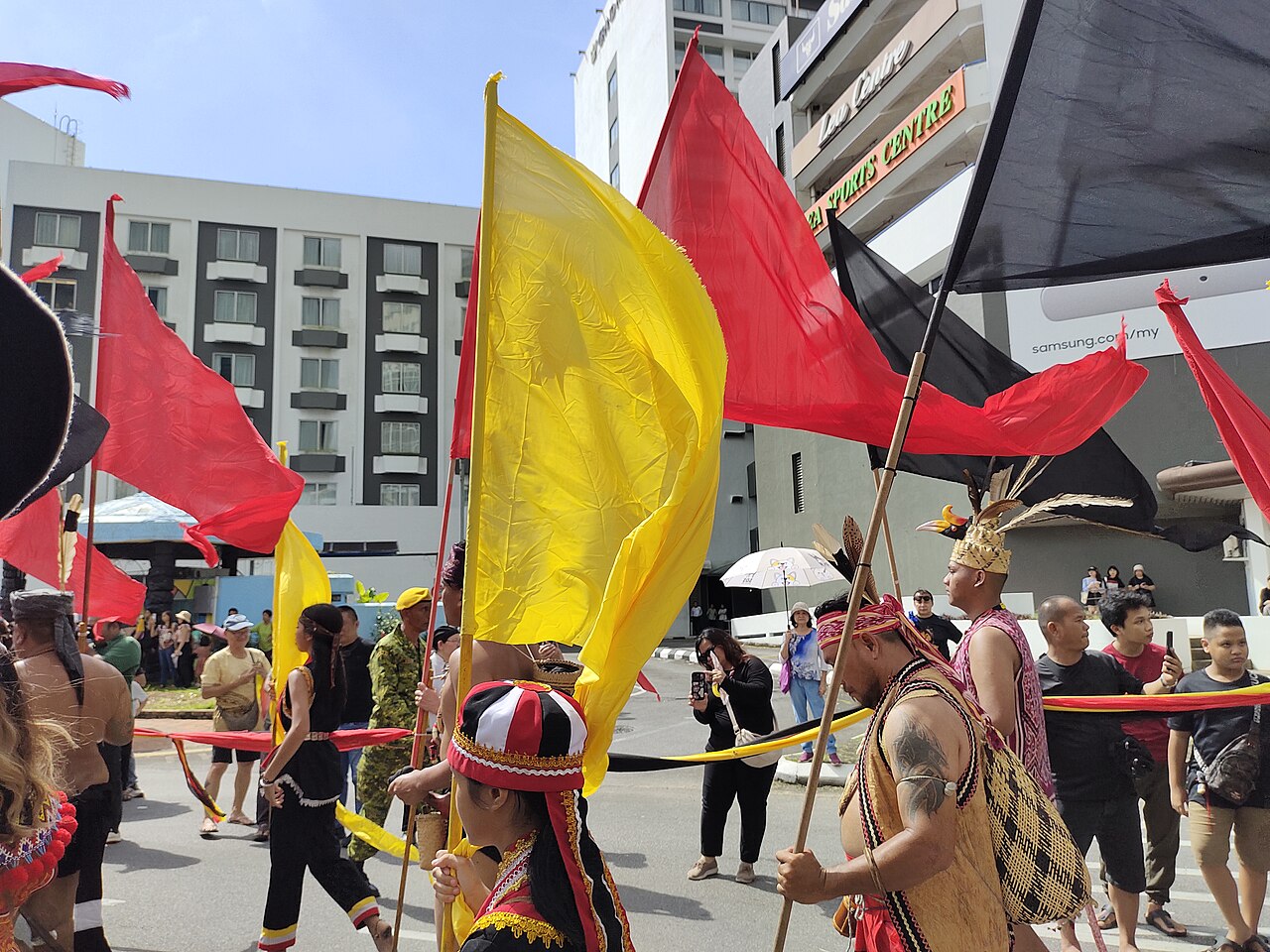
Sabah and Sarawak between them hold dozens of indigenous groups, and in both states the indigenous population outnumbers Malays. In Sarawak the largest group is the Iban, historically longhouse-dwelling and known for the annual Gawai Dayak harvest festival on 1–2 June, followed by the Bidayuh, Melanau and the inland Orang Ulu peoples including the Kenyah and Kayan. In Sabah, the Kadazan-Dusun are the largest group, with the Bajau — the “sea gypsies” of the east coast — and the Murut also significant.
Christianity is widespread in both states, alongside Islam and surviving animist practice. Sabah celebrates the Kaamatan harvest festival on 30–31 May and Sarawak celebrates Gawai on 1–2 June, both state public holidays that the peninsula does not observe. A longhouse visit arranged through a Kuching or Kota Kinabalu operator is the best way to see this culture properly — see our Kuching travel guide.
The Orang Asli
The Orang Asli — literally “original people” — are the indigenous peoples of Peninsular Malaysia, numbering 221,098 in 2024. They are officially divided into 18 recognised sub-groups across three clusters: the Negrito or Semang, the Senoi, and the Proto-Malay. Some, such as the Batek and the Semelai, live in and around Taman Negara and other forest reserves; others are largely settled and urbanised.
Visits to Orang Asli settlements are offered from Taman Negara and elsewhere. The good ones are arranged with the community’s consent and involve genuine explanation of blowpipe hunting and fire-making; the poor ones are extractive and uncomfortable. Ask your operator who benefits before you book. Our Taman Negara guide covers the options there, and our guide to the indigenous peoples of Malaysia prices up every visit option and gives a seven-point checklist for screening an operator.
The communities in between
Five hundred years of trade through the Straits of Melaka produced several creole communities that belong to no single category, and they are among the most interesting things in the country.
The Peranakan, also called Baba-Nyonya or Straits Chinese, descend from unions between Chinese traders and local women from the 15th century onward. They speak a Malay-inflected creole, dress in the nyonya kebaya, and cook a cuisine — Nyonya food — that fuses Chinese technique with Malay ingredients into something neither. Melaka and Penang are the heartlands, and the Baba-Nyonya Heritage Museum in Melaka is the best single introduction — though it closes on Tuesdays, which ruins more itineraries than anything else in the state. See our Melaka travel guide, and our full account of Peranakan heritage in Melaka and Penang for museum prices, closure days and a costed two-day route.
Parallel communities include the Chitty, Tamil-Malay Peranakans centred on Kampung Chitty in Melaka; the Jawi Peranakan of Penang, of Indian Muslim and Malay descent; and the Kristang, Portuguese-Eurasian Catholics in Melaka descended from 16th-century unions, who still speak a Portuguese creole and hold a Feast of St Peter each June. These groups are small, and each is a direct trace of a specific century of trade.
Religion
| Faith | Share (2020 census) | Approximate number |
|---|---|---|
| Islam | 63.5% | 20.6 million |
| Buddhism | 18.7% | 6.1 million |
| Christianity | 9.1% | 2.9 million |
| Hinduism | 6.1% | 2.0 million |
| No religion | 1.8% | — |
| Other (incl. Taoism, Sikhism, animism) | 0.9% | — |
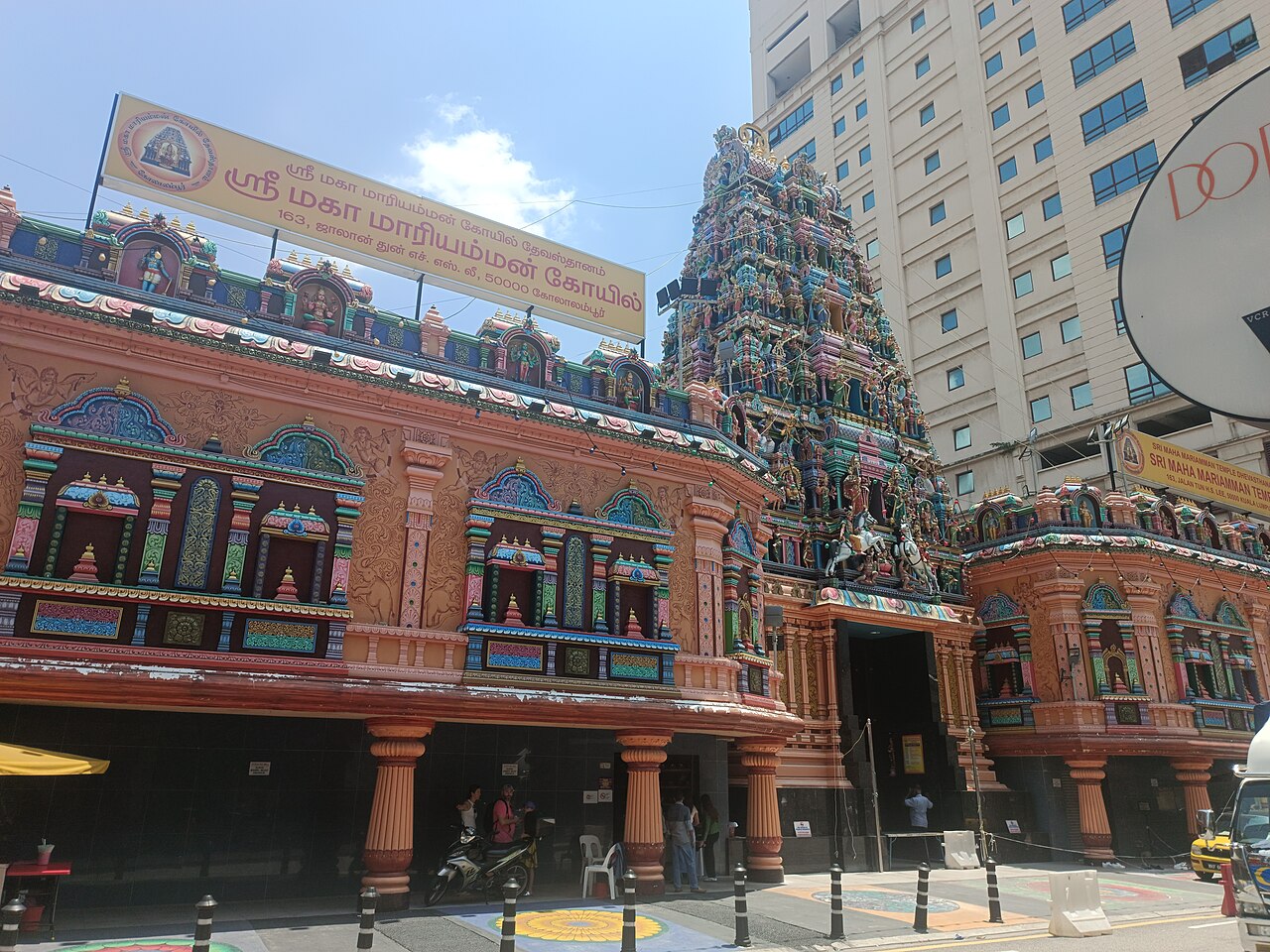
What this looks like on the ground is a national mosque, a Chinese temple, a Hindu temple and a colonial-era church sitting within a few streets of each other in almost every old town centre — and, in Kuala Lumpur, the Masjid Jamek, the Sri Mahamariamman Temple and the Guan Di Temple within a ten-minute walk. This is not a tourist arrangement; it is how the cities grew.
Practically, the call to prayer sounds five times a day, Friday midday prayers empty offices for a couple of hours, and Kelantan, Terengganu and Kedah take Friday and Saturday as the weekend rather than Saturday and Sunday — Johor used to, but reverted to a Saturday–Sunday weekend in January 2025. Plan accordingly if you are travelling in those states — banks, government offices and some businesses close on Friday. Our guide to Islam in Malaysia sets out mosque visiting hours, how the robe counter works and which rules actually apply to non-Muslim visitors.
Language
The national language is Bahasa Malaysia, a standardised Malay written in the Latin alphabet, and it is the language of government, schooling and public signage. English is very widely spoken, especially in cities and in the tourism and business sectors, and Malaysia is among the easiest countries in Asia for an English-speaking visitor to navigate.
Beneath those two, the linguistic map is extraordinary. Ethnologue counts 132 languages in Malaysia — 111 indigenous and 21 non-indigenous. Mandarin and several Chinese dialects, Tamil, Iban, Kadazan-Dusun, Bidayuh and dozens of smaller Bornean and Orang Asli languages are all in daily use. Kelantanese Malay is different enough from the standard language that speakers from Kuala Lumpur sometimes struggle with it.
What you will actually encounter is Manglish: English with Malay and Hokkien grammar and particles layered on. “Can or not?”, “Can lah”, “Don’t have”, “Where got?” — the lah at the end of a sentence is a softener, not a tic. Learning ten words of Malay is disproportionately appreciated: terima kasih (thank you), selamat pagi (good morning), berapa (how much), sedap (delicious). Our Malaysia language guide has a practical list.
Festivals and the open house
Malaysia has 11 gazetted national public holidays plus two to four state holidays, giving 13 to 17 in any given state — one of the higher totals anywhere. The calendar runs on four systems simultaneously: the Gregorian, the Islamic lunar, the Chinese lunisolar and the Hindu Tamil. Most dates therefore move each year, and Islamic dates are confirmed only by moon sighting.
The major festivals are Hari Raya Aidilfitri at the end of Ramadan, Chinese New Year, Deepavali, Wesak Day, Hari Raya Haji, Thaipusam, Christmas, and the harvest festivals of Kaamatan in Sabah and Gawai Dayak in Sarawak. Merdeka Day on 31 August marks independence in 1957; Malaysia Day on 16 September marks the formation of the federation in 1963. Our Malaysia festivals calendar sets out every date with the state variations.
Rumah terbuka: the tradition worth planning around
The rumah terbuka, or open house, is the most distinctively Malaysian institution there is. At Hari Raya, Chinese New Year, Deepavali and Christmas, households hold open house — food laid out, doors open, guests of any background welcome, including people the host has never met. Colleagues visit colleagues, neighbours visit neighbours, and the visiting deliberately crosses communal lines.
Government departments, companies and the Prime Minister host large public open houses that anyone may attend, and these are announced in advance. If you are in Malaysia during a major festival, going to one is the single best cultural experience available to a visitor, and it costs nothing. Bring nothing, eat, say terima kasih, and leave when the room turns over.
The counterpart is balik kampung, the return to the home village. Around Hari Raya and Chinese New Year a large share of the country travels simultaneously. Bus fares rise 30 to 80 percent, trains and domestic flights sell out weeks ahead, and highways gridlock. It is a fascinating time to be in Malaysia and a difficult time to move around it — our guides to Hari Raya Aidilfitri and Chinese New Year in Malaysia give the 2027 dates, the booking windows and, in both cases, the argument for staying put in the city everyone else has left.
Food as the shared culture
If Malaysian culture has a genuinely common ground, it is the hawker centre. Malay, Chinese and Indian stalls operate side by side, sharing tables and a drinks vendor, and people of every background eat at all three. Food is the one area where the communal boundaries are consistently and casually crossed.
The national dish, nasi lemak, is Malay. Char kway teow is Chinese. Roti canai is Indian Muslim. Laksa exists in a dozen regional versions that belong to different communities and sometimes to no one. Nyonya cooking is Peranakan. Sarawak’s kolo mee and Sabah’s hinava belong to neither peninsula tradition. Our Malaysian food guide maps the whole landscape, Malaysian food by region covers the geography, and must-try Malaysian dishes is the shortlist.
A few things follow from religion. Most restaurants and all Malay stalls are halal, and pork is served openly only at Chinese and some Western establishments. Beef is avoided by observant Hindus. Many Chinese Malaysians eat vegetarian on the first and fifteenth of the lunar month, which is why vegetarian stalls appear and vanish on a cycle. Our halal food in Malaysia and vegetarian food in Malaysia guides cover the practicalities.
Arts, crafts and what UNESCO has recognised
Malaysia has nine elements on UNESCO’s Intangible Cultural Heritage lists, which is a useful shortcut to what the country itself regards as culturally load-bearing.
| Element | Inscribed | What it is |
|---|---|---|
| Mak Yong | 2008 | Kelantanese dance-drama, pre-Islamic in origin |
| Dondang Sayang | 2018 | Malay-Baba love-song form from Melaka, sung in quatrains |
| Silat | 2019 | Malay martial art, also performed at weddings |
| Pantun | 2020 | Four-line oral poetry, shared with Indonesia |
| Wangkang | 2020 | Melaka Chinese ship procession rite |
| Songket | 2021 | Hand-woven silk brocade with gold or silver thread |
| Mek Mulung | 2023 | Kedah village theatre combining dance, drama and music |
| Kebaya | 2024 | Multi-national inscription with Indonesia, Singapore, Thailand, Brunei |
| Malaysian Breakfast Culture | 2024 | Nasi lemak, roti canai, kopitiam and mamak breakfast practice |
The wau, the giant decorated kite of the east coast, is not yet inscribed but has been targeted for a multi-national nomination. Batik, wood carving, silverwork, pewter and rattan weaving are all still practised commercially, and the east coast and Sarawak are where to buy the real thing rather than the printed imitation. Our shopping in Malaysia guide covers where to buy, and our guide to Malaysian arts and crafts gives the four-second reverse-side test that separates hand-drawn batik from a machine print.
The six World Heritage Sites
| Site | Inscribed | Type | Where |
|---|---|---|---|
| Gunung Mulu National Park | 2000 | Natural | Sarawak |
| Kinabalu Park | 2000 | Natural | Sabah |
| Melaka and George Town | 2008 | Cultural | Melaka and Penang |
| Lenggong Valley | 2012 | Cultural | Perak |
| Niah Caves | 2024 | Cultural | Sarawak |
| FRIM Selangor Forest Park | 2025 | Cultural | Selangor |
Two of those are recent and almost no guidebook lists them. The Niah Caves in Sarawak were inscribed in July 2024 for evidence of human occupation stretching back some 40,000 years, including the oldest modern human remains found in island Southeast Asia. The Forest Research Institute Malaysia park at Kepong, half an hour from central Kuala Lumpur, was inscribed in July 2025 as a cultural landscape — a century-old experiment in reforesting exhausted tin-mining land, and the world’s oldest man-made tropical rainforest.
The two Straits cities, inscribed jointly in 2008, are the ones most travellers encounter. What UNESCO recognised in George Town and Melaka is not a single monument but a surviving multicultural urban fabric — shophouses, clan associations, temples, mosques and churches in continuing use. See our Penang travel guide and Melaka travel guide, and Mulu National Park for the caves. Our complete guide to Malaysia’s UNESCO World Heritage Sites costs out all six with 2026 entry fees and an honest verdict on each.
Etiquette: what visitors actually get wrong
Malaysians are forgiving of foreigners and almost nobody will correct you. That makes it worth getting a handful of things right on your own account.
The right hand
Eat, give, receive and gesture with the right hand. The left is traditionally reserved for bathroom hygiene across Muslim and Hindu cultures alike, and using it to hand someone money, a business card or a plate of food reads as rude even to people who would never say so. If you are carrying something in your right hand, touch your right forearm with your left as you hand something over — the standard local workaround.
The thumb, not the finger
Pointing with the index finger is aggressive. The Malaysian gesture is a closed right fist with the thumb laid on top, used to indicate a direction, a dish on a menu or a person. It looks odd for about a day and then becomes automatic.
Shoes off
Remove your shoes before entering any private home, mosque, Hindu temple or Chinese temple. Some small shops and offices expect it too — if there is a rack of footwear at the door, that is your answer. Slip-on shoes will make your trip easier than laces will.
The salam
The Malay greeting is the salam: both hands lightly clasp the other person’s hands, then you touch your own hand to your chest, over the heart. It is warmer than a handshake and considerably more common. Important qualification: many Malay Muslim women do not shake hands with men outside their family. Wait for a woman to extend her hand; if she does not, a nod and a hand on your own chest is the correct and entirely normal response. The same applies in reverse for men greeting devout Muslim women.
Dress
Covered shoulders and knees is the baseline anywhere outside a beach or a resort pool. Kuala Lumpur is relaxed; Kelantan and Terengganu are noticeably not. Major mosques, including the Masjid Negara and Kuala Lumpur’s Masjid Jamek, lend robes and headscarves free of charge, so you will not be turned away — but arriving already dressed appropriately is better manners. Hindu and Chinese temples generally do not provide cover, so plan for those.
Heads, feet and photographs
Do not pat anyone on the head, including children — the head is considered the seat of the soul in both Malay and Hindu tradition. Do not point the soles of your feet at a person or at a religious image; keep them flat on the floor when sitting cross-legged. Ask before photographing people, particularly at religious sites and above all during Thaipusam, where kavadi bearers are in a devotional state and not performing for cameras.
Our dedicated Malaysian cultural etiquette guide goes further, including business and dining conventions.
Alcohol, Ramadan and the questions people are too polite to ask
Can you drink in Malaysia?
Yes, if you are not Muslim. Alcohol is legal and openly sold to non-Muslims at licensed premises, supermarkets and convenience stores, and Kuala Lumpur, Penang, Melaka and Kota Kinabalu all have substantial bar scenes. The legal drinking age is 21, raised from 18 with effect from 1 December 2021.
Two qualifications. Malaysia taxes alcohol heavily, so a large beer in a bar runs RM18–25 and imported spirits are expensive — Langkawi and Labuan are duty-free and priced very differently. And Muslims are prohibited from drinking under syariah law, with penalties in the Federal Territories running up to a RM3,000 fine and two years’ imprisonment; Kelantan and Terengganu are stricter still and are effectively dry states where you should not expect to find alcohol at all. None of this applies to non-Muslim visitors, but it explains the geography. Our Malaysia nightlife guide covers where the scene actually is.
Visiting during Ramadan
Ramadan is a good time to visit Malaysia, not a bad one. Non-Muslims are under no obligation to fast and may eat and drink publicly; restaurants stay open and food courts operate normally. Discretion rather than concealment is the norm — most people simply avoid eating conspicuously in front of someone who is fasting, in the same spirit as not smoking in a queue.
The compensation is the bazar Ramadan, the afternoon markets that appear in every town from around 4pm until the breaking of the fast at sunset. They are the best street food of the year, they welcome everyone, and they vanish the moment the month ends. Ramadan in 2027 is expected to begin around 8 February, with Hari Raya Aidilfitri around 10 March — both subject to moon sighting, so treat them as estimates until confirmed. Our night markets guide covers the format.
Is it a conservative country?
It varies enormously by state and by setting, which is the honest answer. Kuala Lumpur and Penang are cosmopolitan and unbothered. Kelantan and Terengganu are conservative in a way that is immediately visible in dress, in the absence of alcohol, in separate supermarket checkout queues for men and women in some towns, and in a Friday–Saturday weekend. Sabah and Sarawak, with their Christian and indigenous majorities, are more relaxed than the peninsula on almost every measure.
Same-sex relationships are criminalised under both civil and syariah law, and while prosecution of foreign visitors is essentially unheard of, discretion is advisable. Public displays of affection between any couple are best kept modest, particularly outside the big cities.
Where to actually experience this
| What you want to see | Where to go | When |
|---|---|---|
| Peranakan culture | Melaka, then George Town | Any time |
| Malay craft as living practice | Kota Bharu, Kuala Terengganu | Avoid Fridays |
| Hindu devotion at scale | Batu Caves, Penang’s Waterfall Temple | Thaipusam, January or February |
| Chinese temple culture | Penang, Ipoh, Melaka | Chinese New Year, Nine Emperor Gods |
| Indigenous Borneo | Sarawak Cultural Village, longhouse stays | Gawai (1–2 Jun), Kaamatan (30–31 May) |
| Colonial and multicultural fabric | George Town, Melaka, Ipoh, Taiping | Any time |
| Museums | Islamic Arts Museum KL, Borneo Cultures Museum Kuching | Any time |
The Islamic Arts Museum Malaysia in Kuala Lumpur is the finest museum in the country and one of the best of its kind anywhere, and it is consistently underrated by visitors who assume it is narrow in scope. The Borneo Cultures Museum in Kuching, opened in 2022, is the best introduction to indigenous Sarawak. Our best museums in Malaysia guide covers both plus the rest.
Frequently asked questions
What is Malaysian culture known for?
For being genuinely plural rather than assimilated. Malay, Chinese, Indian and indigenous communities have retained distinct languages, religions, festivals and cuisines while sharing public space, and the hawker centre — where all four eat side by side — is the clearest expression of it. Malaysia is also known for its food, for the open house tradition at festivals, and for a multi-faith public holiday calendar that runs on four different systems at once.
What are the three main ethnic groups in Malaysia?
Malay (58.2% of citizens), Chinese (22.2%) and Indian (6.5%), with a further 12.3% classified as other Bumiputera — chiefly the indigenous peoples of Sabah and Sarawak plus the Orang Asli of the peninsula, who numbered 221,098 in 2024 across 18 recognised sub-groups.
What is the main religion in Malaysia?
Islam, which is the religion of the Federation and was professed by 63.5% of the population at the 2020 census — around 20.6 million people. Buddhism follows at 18.7%, Christianity at 9.1% and Hinduism at 6.1%. Other faiths may be practised freely, and Sabah and Sarawak have large Christian populations.
What should tourists not do in Malaysia?
Do not hand things over or eat with the left hand, do not point with your index finger, do not wear shoes into a home or place of worship, do not touch anyone’s head, and do not photograph people at religious ceremonies without asking. Dress modestly outside beaches and resorts, particularly in Kelantan and Terengganu. Avoid casual conversation about race, religion and the monarchy — all three are legally and socially sensitive in ways that are not obvious to visitors.
What is the traditional dress of Malaysia?
For Malays, the baju melayu for men, usually with a songkok cap and a sampin at the waist, and the baju kurung or baju kebaya for women. Chinese Malaysians wear the cheongsam or samfu on festival occasions, Indian Malaysians the saree or kurta, and Peranakan women the distinctive nyonya kebaya. The kebaya was inscribed on UNESCO’s Intangible Cultural Heritage list in 2024 in a joint nomination with Indonesia, Singapore, Thailand and Brunei.
Can you drink alcohol in Malaysia?
Yes, if you are not Muslim. It is legal and openly sold at licensed premises and supermarkets, with a legal drinking age of 21 since December 2021. It is heavily taxed, so expect RM18–25 for a large beer in a bar. Muslims are prohibited under syariah law, and Kelantan and Terengganu are effectively dry. Langkawi and Labuan are duty-free.
What language do they speak in Malaysia?
Bahasa Malaysia is the national language and English is very widely spoken, especially in cities. Beyond those two, Ethnologue counts 132 languages in the country — 111 indigenous and 21 not — including Mandarin and several Chinese dialects, Tamil, Iban and Kadazan-Dusun. In practice you will hear Manglish, an English creole with Malay and Hokkien grammar layered on.
What is the “open house” tradition in Malaysia?
At Hari Raya, Chinese New Year, Deepavali and Christmas, households hold rumah terbuka — an open house where food is laid out and guests of any background are welcome, including strangers. Government departments, companies and the Prime Minister host large public versions that anyone may attend. For a visitor in Malaysia during a festival, it is the best cultural access available and it costs nothing.
Where to go next
This is the overview; the detail sits in the cluster beneath it. Start with the Malaysia festivals calendar if you are timing a trip around a celebration, and the Thaipusam at Batu Caves guide for the single most extraordinary religious event in the country. Our Malaysian cultural etiquette guide is the practical companion to this page, and the Malaysia travel guide covers the trip-planning basics.
One closing thought. Malaysians will tell you their country is multicultural, and they will also tell you, sometimes in the same conversation, that the communities live more separately than the brochures suggest. Both are true. Holding both in mind is closer to understanding the place than either statement alone.
1 note